Image | Theories on the Origin of Emotions
Published: 08.09.2011
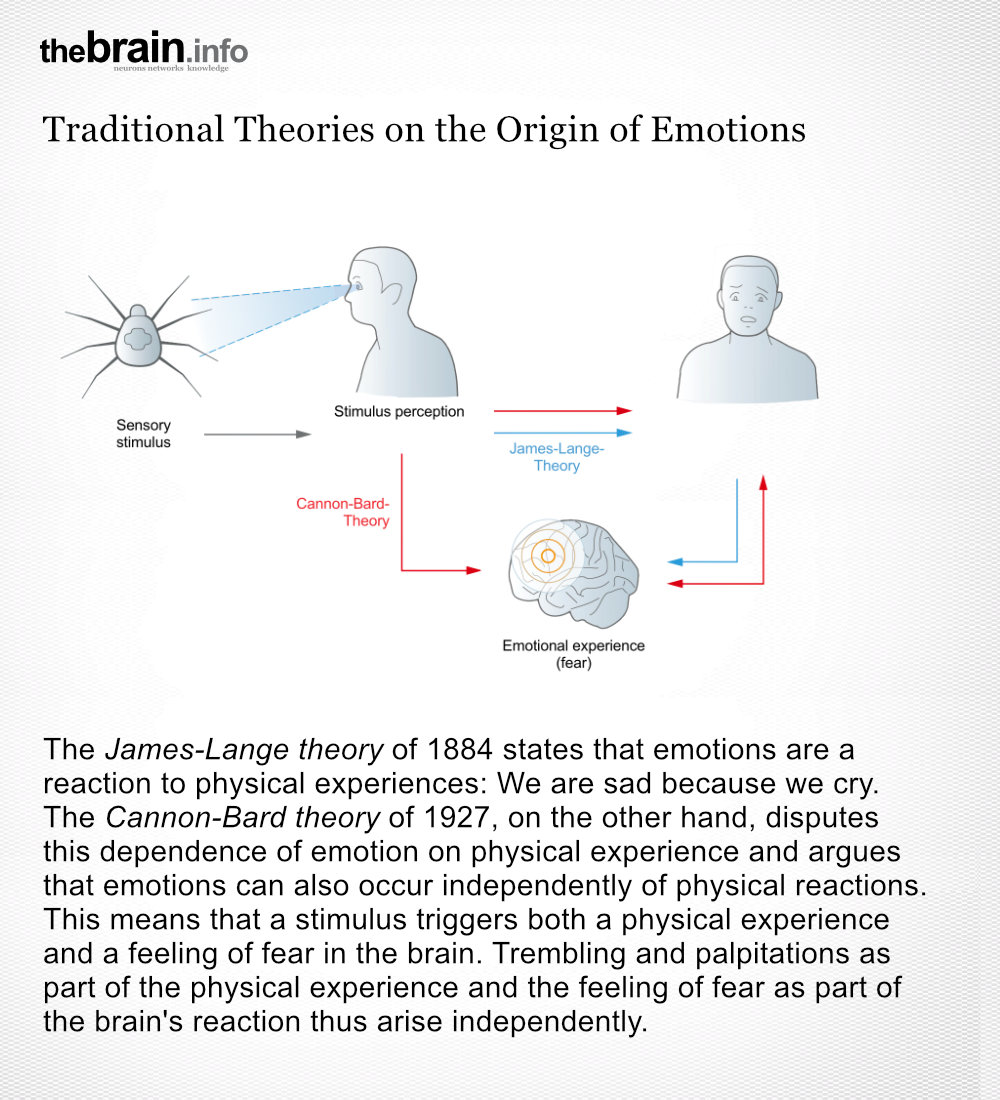
The James-Lange theory and the Cannon-Bard hypothesis assume different ways in which Emotions arise.
You can read more about this topic in our article ▸ On the trail of emotions.
James-Lange theory
A theory of emotion developed by William James and (independently) Carl Lange in 1884, which assumes that emotions go through a kind of loop before they become conscious: the brain processes sensory signals, to which it responds by causing changes in the organism. It is only on the basis of these physical processes that the emotion becomes conscious. For example, the heart beats faster, which promotes the emotion of fear.
Emotions
Neuroscientists understand "emotions" to be complex response patterns that include experiential, physiological, and behavioral components. They arise in response to personally relevant or significant events and generate a willingness to act, through which the individual attempts to deal with the situation. Emotions typically occur with subjective experience (feeling), but differ from pure feeling in that they involve conscious or implicit engagement with the environment. Emotions arise in the limbic system, among other places, which is a phylogenetically ancient part of the brain. Psychologist Paul Ekman has defined six cross-cultural Basic emotions that are reflected in characteristic Facial expressions joy, anger, fear, surprise, sadness, and disgust.
Emotions
Neuroscientists understand "emotions" to be complex response patterns that include experiential, physiological, and behavioral components. They arise in response to personally relevant or significant events and generate a willingness to act, through which the individual attempts to deal with the situation. Emotions typically occur with subjective experience (feeling), but differ from pure feeling in that they involve conscious or implicit engagement with the environment. Emotions arise in the limbic system, among other places, which is a phylogenetically ancient part of the brain. Psychologist Paul Ekman has defined six cross-cultural basic emotions that are reflected in characteristic facial expressions: joy, anger, fear, surprise, sadness, and disgust.
Basic emotions
Some theories assume that all emotions can be broken down into a few basic emotions. These are also referred to as primary emotions. According to Ekman, these classically include fear, anger, joy, sadness, disgust, and surprise. Primary emotions arise very quickly in response to an event and sometimes subside just as quickly. Over time, they can transition into secondary emotions (e.g., shame, guilt, or pride).
Facial expressions
Five muscle groups control the visible movements on the surface of our faces – and this applies to everyone in the world. Neuroscientists emphasize universal, evolutionarily anchored reactions as the reason for this. For this reason, the basic emotions of fear, anger, disgust, sadness, surprise, and joy leave similar traces on the face everywhere, which we can usually identify reliably even in strangers.