
Female Bonobos hunt more often than Males
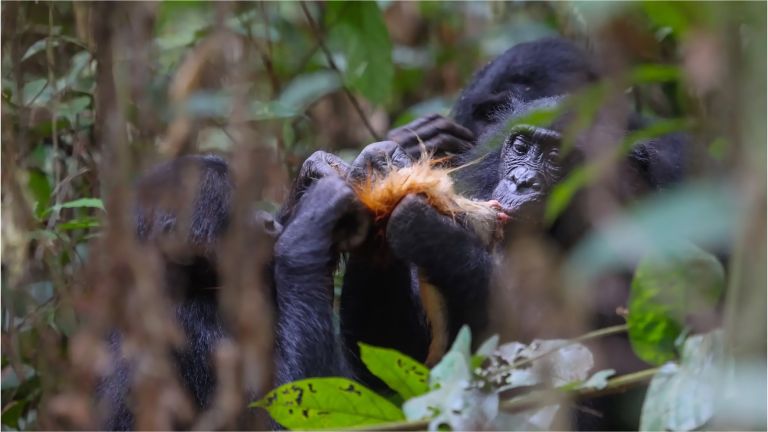
Female bonobos hunt monkeys, which requires a risky chase through the treetops.
Published: 22.10.2026
In a Nutshell
- First Long-Term Study on Hunting Among Bonobos: The study shows that bonobos are skilled and flexible hunters.
- Female Hunters: Female bonobos led 60 percent of the hunts. Females hunted ungulates about three times as often as males and hunted arboreal primates at a similar rate as males.
- Beyond “men as hunters”: The findings challenge the paradigm that hunting among human ancestors was primarily a male behavior.
Among humans, hunting is considered a male domain. Among one of our closest living relatives, however, hunting is primarily a female activity. A ten-year study of wild bonobos shows that hunting is predominantly carried out by females, regardless of whether they are carrying infants. They are just as skilled as males at the dangerous task of hunting monkeys in the tree canopy and are more likely than males to kill large, ground-dwelling prey.
The study, led by researchers at the Max Planck Institute for Behavioral Biology, is the first to examine hunting behavior in two wild bonobo communities over a ten-year period, thereby definitively refuting the species’ reputation as largely non-hunting. “Bonobos not only prey on a wide variety of animals,” says lead author Gottfried Hohmann, “their communities also develop distinct hunting cultures.” The study’s findings also challenge common notions of gender roles among early humans. “Bonobos are a window into humanity’s past,” says lead author Barbara Fruth. “Thanks to these females, we can rethink the image we’ve formed of our hunter-gatherer ancestors.”
An unexpected hunter
Bonobos are not considered great hunters. Among the great apes, it is their closest relative – the chimpanzee –that is known as a notorious hunter. Individual animals can work together in highly coordinated attacks to take down large primates living in the treetops. These hunts are carried out by males who cooperate closely with one another and subsequently divide the prey among themselves. “Among chimpanzees, hunting is a male-dominated activity, since ownership and control of the prey are linked to dominance,” says Fruth. “But what happens in a society where females enjoy high status?”
Bonobos are unique among great apes in that females are on equal footing with males in terms of dominance – and are usually even superior. Fruth and Hohmann wondered whether these powerful females would reverse the trend of male-dominated hunting typical of chimpanzee societies.
After analyzing 415 successful hunts by bonobos in the LuiKotale research area in the Democratic Republic of the Congo, the two researchers found exactly that. Unlike in chimpanzees, hunting among bonobos was female-dominated. Their team examined all successful prey captures observed over a ten-year period in two bonobo groups accustomed to human observation. Since it is not always possible to identify the original hunter, the team analyzed every recorded hunt in which the hunters could be identified, documenting the hunters’ sex and age as well as the prey killed.
In 60 percent of the documented hunts, females were identified as the hunters. “They were the ones who initiated the hunts,” says co-author Mattia Bessone, a postdoctoral researcher at the University of Konstanz and the Max Planck Institute for Behavioral Biology, who led the analysis. “They didn’t opportunistically take prey away from the males.”
Females also hunted regardless of whether they had dependent offspring or not, refuting the notion that mothers avoid hunting to protect their young. The prey posing the highest risk – tree-dwelling monkeys such as the red-tailed monkey – was hunted equally by males and females. Hohmann found this remarkable. “Young females chase monkeys up into the treetops, where they defend themselves. That’s a really dangerous business,” he says.
Age also influenced what the females hunted. Younger females pursued primates in the treetops, while older females targeted large, ground-dwelling ungulates such as forest antelopes and killed them three times as often as males. Once they’ve caught the antelope, the females enjoy the privilege of keeping their impressive prey. The power of the females, according to the authors, is the secret to their success. “Catching prey is one thing; having control over it is another,” says Hohmann. “It’s possible that males don’t catch large prey to avoid conflicts with females over the meat.”
Beyond “Man as Hunter”
The findings raise questions about the hunting habits of the last common ancestor of humans, bonobos, and chimpanzees, who lived five to seven million years ago. “The behavior of chimpanzees alone may not provide a reliable picture of how this ancestor hunted,” says Fruth. The findings thus challenge a common narrative about human evolution: that hunting was primarily a male activity. If female bonobos can be the primary hunters in a society where females hold high status, male-dominated hunting was not necessarily the only option available to our ancestors.
The team also compared the hunting behaviors of the two neighboring bonobo groups. Despite having access to the same prey, they differed in what they hunted. While one group hunted mainly terrestrial mammals, the other specialized in hunting monkeys. The results suggest that bonobo hunting is shaped more by local traditions than by the availability of prey.
The team plans to further investigate these differences. It aims to explore how hunting strategies differ between communities and how they change over time.
Original publication
Gottfried Hohmann, Mattia Bessone, Nadia Balduccio, Francesca Decina, Tanguy Deville, Sonya Pashchevskaya, Valeska Soliday, Kathrine Stewart, Barbara Fruth; Females shape hunting of vertebrates in wild bonobos;
Current Biology
Source
