
Remote-Control in the Cortex: How distant Synapses are equipped for Change
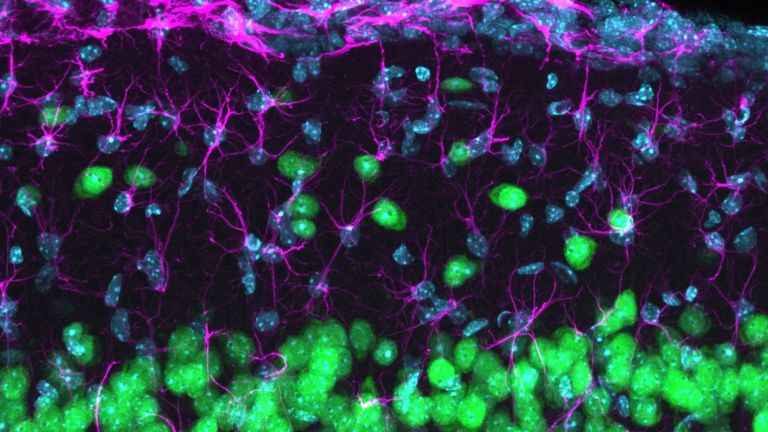
New study finds extensive mRNA localization and local protein synthesis in cortical layer 1, a key site for synaptic plasticity, perception and learning
Published: 30.09.2026
The outermost layer of the brain’s cerebral Cortex is a major meeting point for information coming from across the brain. Researchers at the Max Planck Institute for Brain Research have now discovered that synapses in this thin layer can produce proteins locally. Published in Cell Reports, the study provides the first comprehensive molecular map of cortical layer 1 and its synapses, revealing a specialized signature and unexpected similarities with the hippocampus.
Cortex
cortex cerebri
Cortex refers to a collection of neurons, typically in the form of a thin surface. However, it usually refers to the cerebral cortex, the outermost layer of the cerebrum. It is 2.5 mm to 5 mm thick and rich in nerve cells. The cerebral cortex is heavily folded, comparable to a handkerchief in a cup. This creates numerous convolutions (gyri), fissures (fissurae), and sulci. Unfolded, the surface area of the cortex is approximately 1,800cm².
Hippocampus
The hippocampus is the largest part of the archicortex and an area in the temporal lobe. It is also an important part of the limbic system. Functionally, it is involved in memory processes, but also in spatial orientation and learning. It comprises the subiculum, the dentate gyrus, and the Ammon's horn with its four fields CA1-CA4.
Changes in the structure of the hippocampus due to stress are associated with chronic pain. The hippocampus also plays an important role in the amplification of pain through anxiety.
A molecular supply problem at the brain’s surface
The cerebral Cortex processes sensory information and supports functions ranging from movement to Memory and cognition. Its outermost layer, layer 1, is unusual: unlike deeper cortical layers, it contains very few neuronal cell bodies and consists largely of the distant dendrites of neurons located deeper in the cortex. These dendrites receive many synaptic inputs from many brain areas, including signals carrying “top-down” information (representing environmental context, expectations and internal states of the animal).
Synapses in layer 1 are highly plastic, changing in response to experience and learning. But the molecular mechanisms enabling this Plasticity are not well understood. The long distance of layer 1 synapses from the neuronal cell body raises a logistical challenge: how do they obtain the proteins they need to adapt? One solution is to transport messenger RNAs (mRNAs) from the cell body to distant synapses, where they can serve as instructions to produce proteins locally, at the right place and time. While this process has been studied extensively in the hippocampus, little was known about its role in cortical layer 1.
“We wanted to know whether mRNAs are transported all the way into layer 1 and its synapses, and whether they are actually used there to make new proteins,” says Teresa Spanò, graduate student in the lab of Prof. Erin Schuman and first author of the study. “Because these synapses are so distant from the neuronal cell body, local Protein synthesis could be a powerful strategy to allow them to respond rapidly and precisely to changes in activity.”
Cortex
cortex cerebri
Cortex refers to a collection of neurons, typically in the form of a thin surface. However, it usually refers to the cerebral cortex, the outermost layer of the cerebrum. It is 2.5 mm to 5 mm thick and rich in nerve cells. The cerebral cortex is heavily folded, comparable to a handkerchief in a cup. This creates numerous convolutions (gyri), fissures (fissurae), and sulci. Unfolded, the surface area of the cortex is approximately 1,800cm².
Memory
Memory is a generic term for all types of information storage in the organism. In addition to pure retention, this also includes the absorption of information, its organization, and retrieval.
Plasticity
Neuroplasticity
The term neuroplasticity describes the ability of synapses, nerve cells, and entire areas of the brain to change structurally and functionally depending on the degree to which they are used. Synaptic plasticity refers to the adaptation of the signal transmission strength of synapses to the frequency and intensity of incoming stimuli, for example in the form of long-term potentiation or depression. In addition, the size, interconnection, and activity patterns of different areas of the brain also change depending on their use. This phenomenon is referred to as cortical plasticity when it specifically affects the cortex.
Protein synthesis
The process by which cells translate units of information on DNA into functional carriers in the form of proteins. According to the central dogma of molecular biology, this process consists of two phases: During transcription, a section of genetic material is transcribed into mRNA. This tells the cell the sequence in which it should assemble individual amino acids into a protein. This happens during translation. After translation, some proteins still need to be folded or modified in other ways before they can be used as structural proteins or enzymes.
More than 1,000 mRNAs at excitatory synapses
Using a combination of laser-capture microdissection of tissue, RNA sequencing, fluorescence in situ hybridization and biochemical approaches, the researchers showed that layer 1 contains localized mRNAs and actively synthesizes new proteins. To determine which transcripts were present directly at synaptic sites, they then isolated excitatory and inhibitory synapses from layer 1. At excitatory synapses alone, the team identified more than 1,000 different localized mRNAs.
The researchers also compared the synapses in layer 1 with those found in deeper layers of the Cortex (where the neuronal cell bodies are found) and discovered substantial differences in their transcriptomes - the collections of RNA molecules present. The results indicate that mRNA localization is not uniform throughout the cortex: Instead, it is specialized according to the location of the synapses in the cortical network.
excitatory
Exciting synapses are described as excitatory when they depolarize the subsequent cell membrane and can thus lead to the formation of an action potential. An excitatory effect is usually produced by an exciting transmitter (messenger substance), such as glutamate. The opposite is an inhibitory synapse.
Cortex
cortex cerebri
Cortex refers to a collection of neurons, typically in the form of a thin surface. However, it usually refers to the cerebral cortex, the outermost layer of the cerebrum. It is 2.5 mm to 5 mm thick and rich in nerve cells. The cerebral cortex is heavily folded, comparable to a handkerchief in a cup. This creates numerous convolutions (gyri), fissures (fissurae), and sulci. Unfolded, the surface area of the cortex is approximately 1,800cm².
An unexpected connection to the hippocampus
A surprising finding emerged when the researchers compared cortical layer 1 with the hippocampus, where local mRNA translation has been extensively studied. They found a striking similarity with one hippocampal layer in particular: the stratum lacunosum moleculare, which, like cortical layer 1, contains distal portions of neuronal dendrites.
Unexpectedly, this similarity was not primarily driven by synaptic mRNAs, but also by transcripts associated with glial and immune cells, and the extracellular matrix. This suggests that these distal layers share a broader molecular architecture extending beyond dendrites and synapses.
“Our findings suggest that distal dendritic compartments in different parts of the brain may have a conserved molecular organization, which could be important for their function” says Spanò. “They also highlight components such as Glial cells and the extracellular matrix, which may play a very important role for neuronal function in these distal layers.”
Glial cells
Glia cells are the second largest group of cells in the brain after neurons. For a long time, they were considered inactive elements of the brain, referred to as "nerve cement." Today, we know that the different types of glia cells (astrocytes, oligodendrocytes, and microglia in the CNS; Schwann cells in the PNS) perform clearly defined tasks in the nervous system. For example, they respond to pathogens, play an important role in nourishing nerve cells, and insulate nerve fibers. They account for slightly more than 50 percent of the brain's cells, compared to neurons.
A new resource for understanding cortical plasticity
The findings establish local Protein synthesis as a key feature of cortical layer 1 and provide a molecular framework for understanding how its synapses are maintained and modified. This local protein production could help synapses adapt during learning, while differences between layer 1 and deeper layers point to distinct molecular programs across the cortex.
The work may also help researchers study disorders involving altered cortical circuitry and synaptic function, including Autism spectrum disorders. The new datasets, available at www.syndive.org, allow scientists to examine whether disease-associated molecules are localized to layer 1 and its synapses.
“Our study provides a molecular map of a part of the cortex that has been difficult to investigate,” says Erin Schuman. “It shows that layer 1 is not simply a place where distant synapses receive information - it has a rich local molecular mRNA environment that may help those synapses maintain themselves and adapt, processing information locally”.
Protein synthesis
The process by which cells translate units of information on DNA into functional carriers in the form of proteins. According to the central dogma of molecular biology, this process consists of two phases: During transcription, a section of genetic material is transcribed into mRNA. This tells the cell the sequence in which it should assemble individual amino acids into a protein. This happens during translation. After translation, some proteins still need to be folded or modified in other ways before they can be used as structural proteins or enzymes.
Cortex
cortex cerebri
Cortex refers to a collection of neurons, typically in the form of a thin surface. However, it usually refers to the cerebral cortex, the outermost layer of the cerebrum. It is 2.5 mm to 5 mm thick and rich in nerve cells. The cerebral cortex is heavily folded, comparable to a handkerchief in a cup. This creates numerous convolutions (gyri), fissures (fissurae), and sulci. Unfolded, the surface area of the cortex is approximately 1,800cm².
Autism
A serious developmental disorder that often manifests itself in reduced social skills, impaired communication, and stereotypical behavior. Today, it is understood to be part of the autism spectrum disorders.
Original publication
Teresa Spanò, Belquis Nassim-Assir, Eva Kaulich, Georgi Tushev, Nicole Fürst, Helene Will, Lucija Marić, Elena Ciirdaeva, and Erin M. Schuman; Localized mRNAs and Protein synthesis in cortical layer 1; Cell Reports (2026)
Source
Protein synthesis
The process by which cells translate units of information on DNA into functional carriers in the form of proteins. According to the central dogma of molecular biology, this process consists of two phases: During transcription, a section of genetic material is transcribed into mRNA. This tells the cell the sequence in which it should assemble individual amino acids into a protein. This happens during translation. After translation, some proteins still need to be folded or modified in other ways before they can be used as structural proteins or enzymes.