
When the body gets in the way: Goffin’s cockatoos show evidence of body awareness
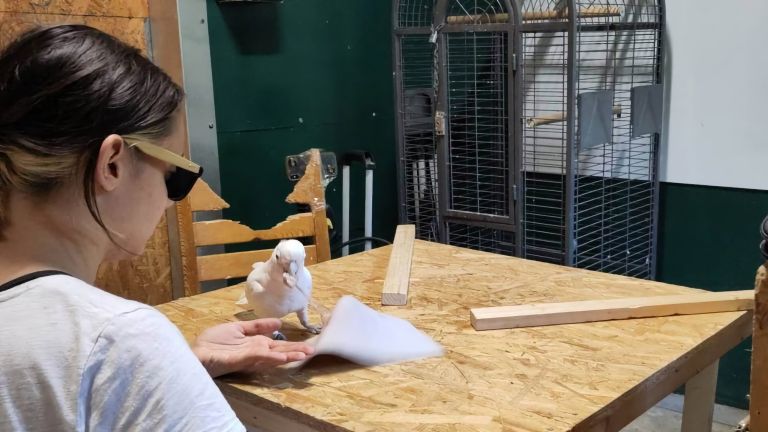
What happens when the obstacle is your own body? For more than half a century, scientists studying the animal self have often turned to mirrors. In the classic mirror mark test, an animal must connect its reflection with its own body and use the mirror to inspect a hidden mark. A new study from the Messerli Research Institute at the University of Veterinary Medicine Vienna explores self-representation through action. In the first body-as-obstacle test conducted with birds, Goffin’s cockatoos recognized when their own weight was preventing them from completing a task and stepped out of the way.
Published: 18.09.2026
For more than half a century, scientists studying animal self-awareness have frequently used mirrors. In the classic mirror-marking test, an animal must associate its reflection with its own body and use the mirror to inspect a hidden mark.
The study by the MFI at the University of Veterinary Medicine, Vienna, investigates self-representation through action. In the first “body-as-obstacle” test conducted with birds, Goffin’s cockatoos recognized when their own weight prevented them from solving a task and stepped aside.
“Probably all animals need to represent themselves in one way or another,” says study co-corresponding author Dr. Antonio J. Osuna-Mascaró. “As Frans de Waal once argued, a monkey needs to know whether a branch can support its weight before landing on it, or whether it has the strength and skill to win a fight before challenging another individual. The mirror test captures one dimension of self-knowledge (visual appearance) within a much broader set that includes smell, size, position, weight, and other traits that help animals navigate physical and social challenges.”
A ball, a mat, and one feathered obstacle
The researchers tested 15 Goffin’s cockatoos at the Goffin Lab in Lower Austria. The birds had learned to pick up a small ball and pass it to an experimenter following a “give me” request.
During the critical test, the ball was connected to the mat beneath the cockatoo’s feet. Pulling the ball also pulled the mat, while the bird’s own weight held everything in place. Success required the cockatoo to step off the mat and continue the transfer from beside it.
Two controls revealed whether the birds were responding to their own causal role in the problem. In one, the ball was unattached and could be passed normally. In the other, it was fixed to the table. This second setup created resistance, while leaving the mat had no effect on the obstruction. A pre-test also confirmed that movement under the birds’ feet rarely prompted them to step away.
“The solution often unfolded in a very clear sequence,” says first author Paula Hundegger, who conducted the experiments. “A cockatoo would pick up the ball, feel the resistance, step off the mat, and complete the transfer. We saw this pattern from the very first session.”
The cockatoos stepped off the mat in 97.8% of test trials. They did so in only 0.7% of trials when the ball was unattached and in 39.1% when it was fixed to the table. The condition-dependent pattern appeared during the first session and remained stable across the experiment. In the pre-test, the birds stayed on the moving mat in 179 of 180 trials.
Together, these results indicate that the cockatoos distinguished between a problem caused by their own body and an external obstruction.
A new window on the animal self
The body-as-obstacle task began with studies of young children. In one version, a child tries to hand over a mat while standing on it. Children generally begin solving such problems during the second year of life, around the period when mirror self-recognition also emerges. The two tasks show only modest associations, and cross-cultural studies have found different developmental patterns, suggesting that they capture distinct aspects of self-representation.
Researchers later adapted the task for Asian elephants, dogs, chimpanzees, and gorillas. Elephants have shown evidence in both mirror and body-as-obstacle tasks. Dogs succeed in body-as-obstacle tasks despite failing conventional mirror tests. Chimpanzees and gorillas have also performed well in body-as-obstacle tests, with no clear relationship between their performance there and their responses to mirrors.
Goffin’s cockatoos add the first avian evidence to this comparative picture. These highly innovative parrots explore objects intensively with their beaks, tongues, and feet. Their tactile and action-centered way of interacting with the world makes them strong candidates for tests based on body-environment relationships. Previous experiments found no conventional mirror self-recognition in this species, although the researchers observed some possible contingency-checking behavior.
“We are learning how self-representation can be studied across very different kinds of minds,” says Osuna-Mascaró. “The emerging picture is modular: different species may rely on the forms of self-knowledge that matter most for how they move and act.”
The findings indicate that the cockatoos were sensitive to their own causal role in a physical problem. The researchers emphasize that the findings should not be interpreted as evidence that cockatoos possess a human-like, reflective concept of themselves. Their way of representing themselves is likely shaped by the physical and social challenges they face. The results add to evidence that self-representation may consist of several components, expressed differently across species and best studied through complementary methods adapted to how each animal perceives and acts in its environment.
“Instead of treating self-awareness as a single threshold, we can ask what information animals use about themselves, under which circumstances, and for what purpose,” Osuna-Mascaró concludes. “Testing the body-as-obstacle paradigm in birds adds a new piece to that much larger puzzle.”
Original publication
Body awareness in Goffin’s cockatoos (Cacatua goffiniana); Paula Hundegger, Remco Folkertsma, Rachel Dale, Alice M. I. Auersperg, Antonio J. Osuna-Mascaró Scientific Reports 16, Article number: 28981 (2026); https://www.nature.com/articles/s41598-026-57500-7