
The Immune System in the Brain: A Study from Magdeburg Supports the Concept of Precision Psychiatry
Biological differences in mental illnesses could be more important than diagnoses alone in the future.
Published: 13.05.2026
Depression, bipolar disorder, and schizophrenia are considered three distinct disorders. Biologically, however, they overlap: inflammatory processes and altered communication between the immune system and the brain may play a role in all three conditions – in a way that cannot be described solely by the traditional diagnosis, but rather by biological subgroups and specific symptoms. This is the conclusion reached by a new systematic review published in the journal Molecular Psychiatry by the Experimental/Translational Psychiatry Research Group at the University Clinic for Psychiatry and Psychotherapy in Magdeburg (led by Prof. Thomas Nickl-Jockschat).
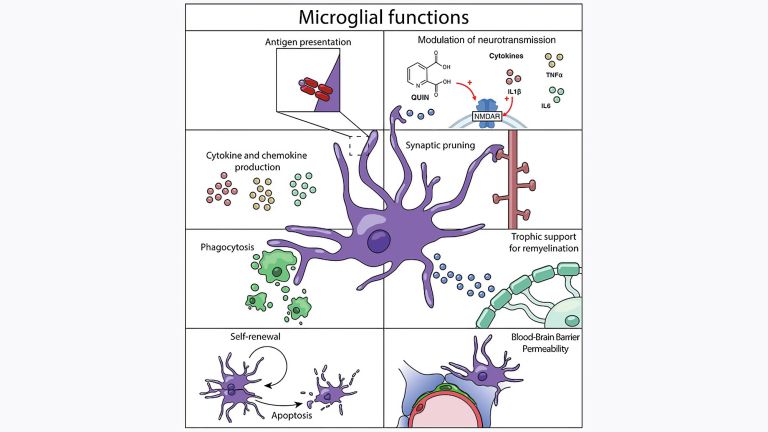
The study focuses on two biological systems: Microglia and the kynurenine metabolic pathway. Microglia are the brain’s immune cells – a kind of maintenance and security service within the nervous tissue. The kynurenine pathway is a metabolic pathway through which the amino acid tryptophan is broken down. This process produces substances that can influence inflammation and signal transmission between nerve cells.
Microglia
The smallest type of glial cell is part of the cellular immune system and is responsible, among other things, for removing dead neurons. Microglia can move in an amoeba-like manner.
Three perspectives on the same problem
A distinctive feature of this study is that the researchers did not merely evaluate a single investigative method, but rather brought together three very different perspectives:
- TSPO-PET imaging: A technique that provides evidence of immune activity in the living brain. Cerebrospinal fluid (CSF): Here, metabolic products of the kynurenine pathway were measured.
- Postmortem brain tissue analyses: Examinations of brain tissue after death, in which Microglia and associated enzymes could be observed directly under the microscope.
“The strength of this work lies in the fact that we bring together different levels of analysis. This provides a more nuanced picture of the role that microglia and immunological metabolic pathways might play in severe mental illnesses,” explains research group leader Prof. Johann Steiner.
Cerebrospinal fluid
liquor cerebrospinalis
A clear fluid that fills the ventricular system and bathes the brain and spinal cord in the subarachnoid space, protecting them from impact. Three to five times a day, 100 to 160 ml of fluid is renewed by the choroid plexus. Certain diseases are reflected in the composition of the cerebrospinal fluid.
Microglia
The smallest type of glial cell is part of the cellular immune system and is responsible, among other things, for removing dead neurons. Microglia can move in an amoeba-like manner.
Different patterns depending on the disease
The results do not paint a straightforward picture. Microglia are not simply activated to the same extent in all mental illnesses. The findings vary depending on the disorder, brain region, and investigative method. In major depression, imaging showed the most consistent pattern: increased immune activity in brain regions important for mood, stress processing, and emotion regulation.
In schizophrenia, the picture was less consistent. The imaging findings varied widely – some studies showed no changes, while others even showed a decrease in the signal. The findings from Cerebrospinal fluid and brain tissue, however, were clearer: they suggest that kynurenine metabolism in schizophrenia is shifted in a specific direction that could impair signal transmission between neurons. This is consistent with a long-standing hypothesis that this very disruption could contribute to psychotic symptoms and cognitive impairments.
For bipolar disorder, the evidence was the most limited. Individual findings suggest changes in certain subgroups – such as patients with psychotic symptoms or suicidal tendencies. However, there are not yet enough studies to draw definitive conclusions.
Microglia
The smallest type of glial cell is part of the cellular immune system and is responsible, among other things, for removing dead neurons. Microglia can move in an amoeba-like manner.
Cerebrospinal fluid
liquor cerebrospinalis
A clear fluid that fills the ventricular system and bathes the brain and spinal cord in the subarachnoid space, protecting them from impact. Three to five times a day, 100 to 160 ml of fluid is renewed by the choroid plexus. Certain diseases are reflected in the composition of the cerebrospinal fluid.
Biological subgroups instead of rigid diagnostic boundaries
The key finding of the study: Changes in Microglia and kynurenine levels likely cannot be explained by the classic diagnosis alone, but are better accounted for by biological subgroups and specific symptoms.
The researchers see this as a potential approach toward a more personalized psychiatry in the future. “Our findings suggest that psychiatric disorders should be viewed in a more dimensional and biological way in the future. It could be crucial whether a patient exhibits pronounced inflammatory activity, psychotic symptoms, cognitive impairments, suicidal tendencies, or a specific phase of the illness – and not just what diagnosis is listed in the discharge summary,” said Prof. Steiner. “It was particularly revealing that the findings from imaging, Cerebrospinal fluid analyses, and brain tissue examinations only come together to form a coherent overall picture when viewed in conjunction. Individual methods alone would not have revealed this nuanced pattern,” adds first author Madeleine Nussbaumer.
This does not mean that traditional diagnoses are becoming obsolete. They remain indispensable for clinical care. However, they may be too vague for research into biological causes: Two people with the same diagnosis can have very different immunological profiles – and conversely, people with different diagnoses may share similar biological changes.
Microglia
The smallest type of glial cell is part of the cellular immune system and is responsible, among other things, for removing dead neurons. Microglia can move in an amoeba-like manner.
Cerebrospinal fluid
liquor cerebrospinalis
A clear fluid that fills the ventricular system and bathes the brain and spinal cord in the subarachnoid space, protecting them from impact. Three to five times a day, 100 to 160 ml of fluid is renewed by the choroid plexus. Certain diseases are reflected in the composition of the cerebrospinal fluid.
What this means for those affected
“For patients, this doesn’t mean that a new test or standard treatment will be available right away,” says Prof. Steiner. “But it shows where the field is headed: away from treatment based purely on trial and error, toward a more precise form of psychiatry that takes biological mechanisms into account to a greater extent.”
Until then, however, further research is needed. Many previous studies have been based on small groups of participants. In addition, there is a lack of long-term studies that track the course of the disease over several years.
Building on previous work
The publication builds on an expert review by the Magdeburg working group, in which schizophrenia was described as a “glial” disorder: a condition in which not only nerve cells but also the brain’s supporting cells play a key role. The new study now extends this perspective to include Microglia and the kynurenine metabolic pathway – for all three disorders collectively.
“Glial cells are not merely the brain’s supporting tissue. They regulate immune responses, synapses, and the stability of neural networks – precisely those functions that could be significant for the onset and progression of a subgroup of mental illnesses,” explains Prof. Steiner.
Microglia
The smallest type of glial cell is part of the cellular immune system and is responsible, among other things, for removing dead neurons. Microglia can move in an amoeba-like manner.
Research by young scholars from Magdeburg
First author Madeleine Nussbaumer is writing her doctoral dissertation in Prof. Steiner’s research group. In December 2025, she was honored as the top graduate of her class at the Magdeburg School of Medicine. The publication in *Molecular Psychiatry* underscores the strong involvement of early-career researchers in internationally recognized research at the Magdeburg campus.
The work was supported by the German Center for Mental Health (DZPG, BMBF grant number 01EE2305A, Halle-Jena-Magdeburg site) as well as a doctoral fellowship from the Faculty of Medicine at Otto von Guericke University Magdeburg.
Original publication
- Nussbaumer, M., Guest, P.C., Schiltz, K. et al. Multimodal microglial and kynurenine pathway alterations across the affective-psychosis spectrum: a systematic review of patterns, heterogeneity, and dimensional implications. Mol Psychiatry (2026). DOI: https://doi.org/10.1038/s41380-026-03614-3
- Bernstein, H.-G., Nussbaumer, M., Vasilevska, V., Dobrowolny, H., Nickl-Jockschat, T., Guest, P.C., Steiner, J. Glial cell deficits are a key feature of schizophrenia: implications for neuronal circuit maintenance and histological differentiation from classical Neurodegeneration. Mol Psychiatry 30, 1102–1116 (2025). DOI: https://doi.org/10.1038/s41380-024-02861-6
Neurodegeneration
Collective term for diseases in which nerve cells gradually lose their structure or function until they eventually die. In many cases, misfolded proteins are the trigger – such as certain forms of the proteins beta-amyloid and tau in the case of Alzheimer's disease. In other diseases, such as Parkinson's disease or Huntington's disease, proteins within the neurons are not broken down properly. As a result, toxic aggregates are deposited there, leading to the respective disease symptoms. While Huntington's disease is clearly genetic, in Parkinson's and Alzheimer's there appear to be certain gene variants that promote their development. None of these neurodegenerative diseases can be cured at present.