Vergiss die Angst – auf Zellebene
Zu viel Angst hinterlässt Spuren im Gehirn. Sie verdichtet Synapsen erst hier, dann dort, und dünnt sie an anderer Stelle aus. Diese zelluläre Plastizität hilft dabei, die Furcht auch wieder zu vergessen: geschickt ausgenutzt fürs Extinktionslernen.
Scientific support: Prof. Dr. Markus Fendt
Published: 24.09.2014
Difficulty: serious
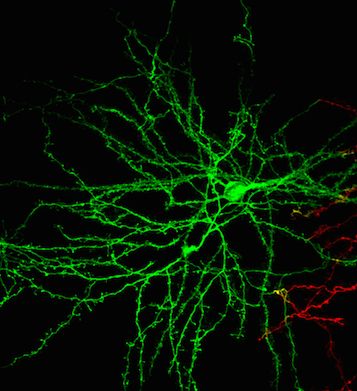
- Angst verändert die Synapsen im Gehirn. Ausstülpungen auf den Zellfortsätzen von Nervenzellen – sogenannte Dornen – wachsen oder schrumpfen. Damit nimmt die Zahl der Synapsen zu oder ab.
- Kurz nach dem Angst-Erlebnis verdichten sich vorübergehend die Synapsen im Hippocampus. Später kommt es zu dauerhaften Veränderungen im Gyrus cinguli und in der Amygdala. Im präfrontalen Cortex nimmt die Zahl der Dornen und somit der Synapsen ab.
- Hohe synaptische Plastizität macht die Spuren der Angst labil. Sie lassen sich leichter ausradieren oder überdecken.
- Wo Gedächtnisinhalte schon länger bestehen, kann synaptische Plastizität durch Erinnerungsübungen oder mit chemischer Hilfe wieder erhöht werden. Das Extinktionstraining funktioniert dann besser.
Hippocampus
The hippocampus is the largest part of the archicortex and an area in the temporal lobe. It is also an important part of the limbic system. Functionally, it is involved in memory processes, but also in spatial orientation and learning. It comprises the subiculum, the dentate gyrus, and the Ammon's horn with its four fields CA1-CA4.
Changes in the structure of the hippocampus due to stress are associated with chronic pain. The hippocampus also plays an important role in the amplification of pain through anxiety.
Amygdala
corpus amygdaloideum
An important core area in the temporal lobe that is associated with emotions: it evaluates the emotional content of a situation and reacts particularly to threats. In this context, it is also activated by pain stimuli and plays an important role in the emotional evaluation of sensory stimuli. Inaddition, it is involved in linking emotions with memories, emotional learning ability, and social behavior. The amygdala is part of the limbic system.
Cortex
cortex cerebri
Cortex refers to a collection of neurons, typically in the form of a thin surface. However, it usually refers to the cerebral cortex, the outermost layer of the cerebrum. It is 2.5 mm to 5 mm thick and rich in nerve cells. The cerebral cortex is heavily folded, comparable to a handkerchief in a cup. This creates numerous convolutions (gyri), fissures (fissurae), and sulci. Unfolded, the surface area of the cortex is approximately 1,800cm².
Der surrende Bohrer beim Zahnarzt, ein Hundebiss, die Fäuste eines gewalttätigen Familienmitglieds, entsetzliche Bilder eines miterlebten Unfalls: Das Gefühl der Angst aus diesen und anderen Situationen findet auf vielen Wegen in unseren Kopf. Einmal dort angekommen, hinterlässt das Gefühl Spuren im Gehirn, verändert die Anordnung von Nervenzellen und die Funktion von Netzwerken. Auf der Suche nach neuen Therapien für Angststörungen lernen Forscher, diese Spuren zu lesen und sie teilweise wieder auszuradieren.
Was die Furcht mit Nervenzellen macht, lässt sich besonders gut in Experimenten studieren, bei denen Wissenschaftler Mäusen das Fürchten beibringen: Den Mäusen werden Töné vorgespielt, begleitet von elektrischen Reizen, die zwar unangenehm sind, aber nicht verletzend. Hört eine derart trainierte Maus später nur den Ton, wird sie trotzdem vor Angst kurz stocksteif – ein Paradebeispiel für eine klassische Konditionierung. Im Gehirn einer derart gepiesackten Maus verändern sich die Verknüpfungen der Nervenzellen in einem Netzwerk, an dem unter anderem das limbische System mit Hippocampus und Amygdala sowie der präfrontale Cortex samt Gyrus cinguli beteiligt sind. Der Hippocampus zum Beispiel ist für die Speicherung neuer Erinnerungen zuständig ist. Und so wachsen dort innerhalb weniger Stunden nach dem Erleben der unangenehmen Paarung von Ton und Elektroschock auf den Fortsätzen der Nervenzellen gewisse Ausstülpungen. An diesen so genannten Dornen können sich neue synaptische Kontakte bilden.
Hippocampus
The hippocampus is the largest part of the archicortex and an area in the temporal lobe. It is also an important part of the limbic system. Functionally, it is involved in memory processes, but also in spatial orientation and learning. It comprises the subiculum, the dentate gyrus, and the Ammon's horn with its four fields CA1-CA4.
Changes in the structure of the hippocampus due to stress are associated with chronic pain. The hippocampus also plays an important role in the amplification of pain through anxiety.
Amygdala
corpus amygdaloideum
An important core area in the temporal lobe that is associated with emotions: it evaluates the emotional content of a situation and reacts particularly to threats. In this context, it is also activated by pain stimuli and plays an important role in the emotional evaluation of sensory stimuli. Inaddition, it is involved in linking emotions with memories, emotional learning ability, and social behavior. The amygdala is part of the limbic system.
Cortex
cortex cerebri
Cortex refers to a collection of neurons, typically in the form of a thin surface. However, it usually refers to the cerebral cortex, the outermost layer of the cerebrum. It is 2.5 mm to 5 mm thick and rich in nerve cells. The cerebral cortex is heavily folded, comparable to a handkerchief in a cup. This creates numerous convolutions (gyri), fissures (fissurae), and sulci. Unfolded, the surface area of the cortex is approximately 1,800cm².
Cortex
cortex cerebri
Cortex refers to a collection of neurons, typically in the form of a thin surface. However, it usually refers to the cerebral cortex, the outermost layer of the cerebrum. It is 2.5 mm to 5 mm thick and rich in nerve cells. The cerebral cortex is heavily folded, comparable to a handkerchief in a cup. This creates numerous convolutions (gyri), fissures (fissurae), and sulci. Unfolded, the surface area of the cortex is approximately 1,800cm².
Spuren der Erinnerungen wandern im Gehirn
Nach einigen Wochen ist von der Synapsenverdichtung im Hippocampus allerdings nichts mehr zu sehen, wenn man in mit Silbernitrat eingefärbten Gehirnschnitten die Dornen zählt (Kampf um die Neuronendoktrin). Dabei haben die Mäuse die Lektion keineswegs vergessen. Beim Erklingen des Tons erstarren sie nach wie vor. Doch die Spuren der Erinnerungen sind in andere Gehirnregionen gewandert, etwa in den Gyrus cinguli. Diese Hirnregion spielt eine wichtige Rolle bei der langfristigen Speicherung von Gedächtnisinhalten und bei der Regulierung von Aufmerksamkeit und Affekten. Dort bleibt die Zahl der Dornen noch Wochen nach dem Lernvorgang erhöht.
Wie genau die Plastizität der Dornen im Hippocampus und Gyrus cinguli mit dem Lernen und Vergessen von Angst zusammenhängt, untersucht derzeit die Pharmakologin Rohini Kuner von der Universität Heidelberg (zur Webseite). Sie vermutet, dass dabei Semaphorine eine wichtige Rolle spielen: Moleküle, die Nervenzellen während der Embryonalentwicklung zeigen, wo entlang sie wachsen sollen, und die auch das Wachstum von Dornen stimulieren können. Semaphorine und ihre Rezeptoren, die Plexine, reichern sich nach der Geburt im Hippocampus und Gyrus cinguli an. Kuner hat die Produktion von Plexinen in diesen Gehirnregionen bei Mäusen dann nach der Geburt ausgeschaltet. Daraufhin hatten die Tiere nach der Konditionierung mit dem elektrischen Reiz weniger Angst vor dem Ton und sie hatten zumindest in sezierten Hirnschnitten auch weniger Dornen als Mäuse mit einer normalen Menge an Plexin-Rezeptoren. Details zu diesen Ergebnissen sind bei Redaktionsschluss im September 2014 noch nicht publiziert. Als Nächstes will Kuner mithilfe eines Multiphotonenmikroskops, das Blicke in den Gyrus cinguli der lebendigen Maus erlaubt, die Dynamik der Dornen beim Lernen und Vergessen von Angst live verfolgen.
Forscher hoffen darauf, mit einem besseren Verständnis davon, wo und wann genau synaptische Plastizität die Angst im Gehirn verankert, auch effektivere Methoden zu entwickeln, um diese Anker wieder zu lösen. Aus der Amygdala, die als eines der Hauptzentren für die Bewertung und emotionale Einordnung möglicher Gefahren ebenfalls eine Rolle bei der Verfestigung der Angst spielt, gibt es hierzu bereits Erfolgsmeldungen. In den Stunden und Tagen nach dem Elektroschock steigt an den postsynaptischen Membranen von Neuronen in der lateralen Amygdala die Zahl der so genannten AMPA-Rezeptoren an, die für eine effektive Signalübertragung an der Synapse wichtig sind. Unter Beteiligung komplexer molekularer Kaskaden entsteht in einigen dieser Zellen ein Muster von Genaktivität, das die Synapsen dauerhaft aktiver feuern lässt. So wird die Angst langfristig verankert.
Will man der Maus nun beibringen, dass sie den Ton nicht mehr zu fürchten braucht, ist ein Extinktionstraining (Extinktion: Umlernen lernen) nötig: Dabei wird das zuvor Gelernte nicht vergessen oder ausgelöscht, sondern etwas Neues gelernt: „Der Ton macht keine Angst.“ Dieser neue Gedächtnisinhalt konkurriert dann mit dem alten Gedächtnisinhalt: „Der Ton macht Angst.“ Um die ängstliche Reaktion zu verlernen, spielt man dem Versuchstier immer wieder einen Ton vor – aber ohne elektrischen Reiz. Das Umlernen funktioniert noch besser, wenn die Erinnerung zuvor durch einmaliges Vorspielen des ursprünglich angstauslösenden Tons frisch abgerufen wird. Dieses einmalige Vorspielen scheint die Spuren der Erinnerung zu labilisieren. Die molekularen Kaskaden, die an der ursprünglichen Kodierung der Erinnerung beteiligt waren, werden wieder aktiv; das Erinnerte muss wohl erneut verfestigt werden. Wird nun in diesem Zeitfenster ein Extinktionstraining durchgeführt, kann der Erfolg mitunter durchschlagend sein und die Angst-Erinnerung dauerhaft vergessen werden. Dabei nimmt die zuvor angestiegene Zahl der AMPA-Rezeptoren wieder ab.
Hippocampus
The hippocampus is the largest part of the archicortex and an area in the temporal lobe. It is also an important part of the limbic system. Functionally, it is involved in memory processes, but also in spatial orientation and learning. It comprises the subiculum, the dentate gyrus, and the Ammon's horn with its four fields CA1-CA4.
Changes in the structure of the hippocampus due to stress are associated with chronic pain. The hippocampus also plays an important role in the amplification of pain through anxiety.
Amygdala
corpus amygdaloideum
An important core area in the temporal lobe that is associated with emotions: it evaluates the emotional content of a situation and reacts particularly to threats. In this context, it is also activated by pain stimuli and plays an important role in the emotional evaluation of sensory stimuli. Inaddition, it is involved in linking emotions with memories, emotional learning ability, and social behavior. The amygdala is part of the limbic system.
Synapse
A synapse is a connection between two neurons and serves as a means of communication between them. It consists of a presynaptic region – the terminal button of the sender neuron – and a postsynaptic region – the region of the receiver neuron with its receptors. Between them lies the synaptic cleft.
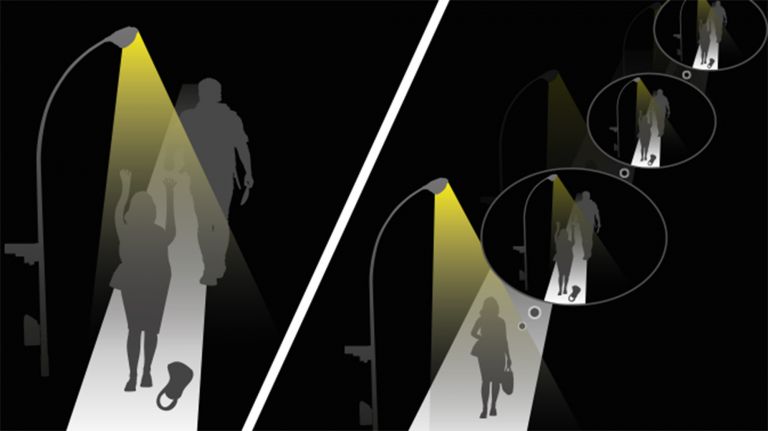
Antibiotikum erleichtert das Verlernen
Noch besser funktioniert das Vergessen mithilfe des Antibiotikums D-Cycloserin (DCS), das auch NMDA-Rezeptoren in der Zellmembran aktiviert: Diese Rezeptoren spielen ebenso wie die AMPA-Rezeptoren eine Rolle bei Lernprozessen. Wird das Präparat rechtzeitig vor einem Extinktionstraining verabreicht, wird das Mengenverhältnis der beiden Rezeptoren zugunsten von NMDA verschoben – und so wird der neue Gedächtnisinhalt schneller gelernt. Auch beim Menschen verbessert die Gabe von DCS den Erfolg einer Expositionstherapie, einer Art des Extinktionstrainings.
Mehr Wissen um die Veränderungen auf Zellebene könnte auch dabei helfen, Ängste dauerhaft auszulöschen. Rückfälle sind bislang häufig – wenn das Verlernen langfristig misslingt, sprechen Experten vom Renewal-Effekt (Wenn Verlernen misslingt), der Erneuerung. Rückfälle deuten darauf hin, dass der Prozess des Umlernens eher neue, beruhigende Gedächtnisinhalte schafft. Diese stehen mit den alten Spuren der Angst eher im Wettbewerb, statt die alten Spuren der Angst wirklich auszulöschen.
Doch in einer Untersuchung der zellulären Veränderungen im präfrontalen Cortex zeigte sich, dass es manchmal eben doch klappt, ein Verhalten zu löschen. Dabei integriert ein Teil des präfrontalen Cortex als Assoziationszentrum aktuelle sensorische Signale unter anderem mit Gedächtnisinhalten und emotionalen Bewertungen aus Amygdala und Hippocampus und spielt so eine wichtige Rolle bei ihrer Neubewertung. Im Zuge der üblichen Konditionierung mit Tönen und Elektroschocks nimmt die Zahl der Dornen im präfrontalen Cortex zuvor ab. Nach einem Extinktionstraining wachsen sie jedoch genau in den zuvor vom Schwund betroffenen Regionen wieder nach. Dass die morphologischen Veränderungen in denselben Zellen stattfinden, deutet darauf hin, dass die Spuren der Angst zumindest in einem winzigen, sehr speziellen Teil des präfrontalen Cortex wirklich ausradiert werden – und nicht nur durch die im Extinktionstraining neu erlernte, harmlosere Assoziation überlagert werden.
Sogar besonders hartnäckige Angst-Erinnerungen könnten gelöscht werden, wenn es nur gelänge, Plastizität auch bei schon seit langer Zeit eingegrabenen Erinnerungen wieder herzustellen. Liegt das Trauma schon lange zurück, zeigt normales Extinktionstraining nur selten Erfolg. Das liegt unter anderem daran, dass die Gene der für neuronale Plastizität benötigten Moleküle dauerhaft abgeschaltet werden. Sogenannte Histon-Deacetylase-Inhibitoren können die Struktur des Genoms allerdings so verändern, dass diese Gene wieder abgelesen werden. So gelang es 2014 im Mausmodell, auch schon seit Langem verfestigte Angsterinnerungen auszulöschen. Die Synapsen im Hippocampus wurden dichter, also wird neuronale Plastizität wieder möglich – und so verlernten die Mäuse im Training ihre Furcht.
Cortex
cortex cerebri
Cortex refers to a collection of neurons, typically in the form of a thin surface. However, it usually refers to the cerebral cortex, the outermost layer of the cerebrum. It is 2.5 mm to 5 mm thick and rich in nerve cells. The cerebral cortex is heavily folded, comparable to a handkerchief in a cup. This creates numerous convolutions (gyri), fissures (fissurae), and sulci. Unfolded, the surface area of the cortex is approximately 1,800cm².
Amygdala
corpus amygdaloideum
An important core area in the temporal lobe that is associated with emotions: it evaluates the emotional content of a situation and reacts particularly to threats. In this context, it is also activated by pain stimuli and plays an important role in the emotional evaluation of sensory stimuli. Inaddition, it is involved in linking emotions with memories, emotional learning ability, and social behavior. The amygdala is part of the limbic system.
Hippocampus
The hippocampus is the largest part of the archicortex and an area in the temporal lobe. It is also an important part of the limbic system. Functionally, it is involved in memory processes, but also in spatial orientation and learning. It comprises the subiculum, the dentate gyrus, and the Ammon's horn with its four fields CA1-CA4.
Changes in the structure of the hippocampus due to stress are associated with chronic pain. The hippocampus also plays an important role in the amplification of pain through anxiety.
Gene
Information unit on DNA. Specialized enzymes translate the core component of a gene into ribonucleic acid (RNA). While some ribonucleic acids perform important functions in the cell themselves, others specify the order in which the cell should assemble individual amino acids into a specific protein. The gene thus provides the code for this protein. In addition, a gene also includes regulatory elements on the DNA that ensure that the gene is read exactly when the cell or organism actually needs its product.
Kiffen fürs Verlernen: Lieber nicht
Bevor Histon-Deacetylasen-Inhibitoren zur Behandlung von Angststörungen eingesetzt werden könnten, sind Studien am Menschen abzuwarten. Experten weisen darauf hin: Diese Inhibitoren sind meist zu unspezifisch und auch toxisch; zumal noch unklar ist, ob nicht auch andere Lerninhalte mitgelöscht würden, die gar nicht gelöscht werden sollten.
Ein anderes potenzielles Angst-Therapeutikum hingegen kann eine lange menschliche Nutzungsgeschichte vorweisen. THC, der Hauptwirkstoff von Cannabis, sorgt nicht nur dafür, dass Kiffer so entspannt wirken, sondern er hilft offenbar auch Menschen mit posttraumatischer Belastungsstörung. Diese Patienten scheitern oft daran, den neuen Gedächtnisinhalt, den sie im Extinktionstraining lernen, zu speichern (PTBS: Wie sich Traumata verlernen lassen). THC scheint die Plastizität im Hippocampus und präfrontalen Cortex, die dafür besonders benötigt wird, anzukurbeln: Bei Probanden, die vor einem Extinktionstraining eine Kapsel mit THC geschluckt hatten, wurden diese Hirnregionen stärker aktiviert, wenn sie sich später an das im Training Gelernte erinnern sollten. Allerdings: Diese Menschen spürten genauso viel Angst wie jene Versuchsteilnehmer, die zur Kontrolle nur ein Scheinpräparat bekommen hatten. Deswegen macht ein Joint keinen Sinn. Zumal Joints ihrerseits auch Panikattacken auslösen können und somit nur neue Angst.
Hippocampus
The hippocampus is the largest part of the archicortex and an area in the temporal lobe. It is also an important part of the limbic system. Functionally, it is involved in memory processes, but also in spatial orientation and learning. It comprises the subiculum, the dentate gyrus, and the Ammon's horn with its four fields CA1-CA4.
Changes in the structure of the hippocampus due to stress are associated with chronic pain. The hippocampus also plays an important role in the amplification of pain through anxiety.
zum Weiterlesen:
- Gräff, J et al.: Epigenetic Priming of Memory Updating during Reconsolidation to Attenuate Remote Fear Memories. Cell 156, 261 – 276, 2014 (zum Abstract).
- Rabinak, CA et al.: Cannabinoid modulation of prefrontal-limbic activation during fear Extinction learning and recall in humans. Neurobiol Learn Mem. 113:125 – 34, 2014 (zum Abstract).
- Lai, CS et al.: Opposite effects of Fear conditioning and extinction on dendritic spine remodelling. Nature, 483(7387):87 – 91, 2012 (zum Abstract).
- Restivo, L et al.: The formation of recent and remote memory is associated with time-dependent formation of Dendritic spines in the Hippocampus and Anterior cingulate cortex Journal of Neuroscience, 29(25):8206 – 14, 2009 (zum Artikel).
- Clem, RL & Huganir, RL et al.: Calcium-Permeable AMPA Receptor Dynamics Mediate Fear Memory Erasure. Science, 313, 1402, 2006 (zum Artikel).
Priming
Priming refers to the influence of previous experiences on perception, reactions, or memory content. This often involves presenting a stimulus (e.g., a word, image, or symbol), often unconsciously or below the threshold of perception. Although the person is not consciously aware of this stimulus, it affects the processing of subsequent stimuli: for example, reactions become faster or memory content is retrieved more easily.
Memory
Memory is a generic term for all types of information storage in the organism. In addition to pure retention, this also includes the absorption of information, its organization, and retrieval.
Extinction
In extinction, a previously conditioned stimulus is presented several times without the originally paired reinforcement until the conditioned response subsides. For example, a dog has learned that the ringing of a bell announces food (conditioned stimulus → conditioned salivation response). In extinction, the bell is now rung several times without food following. After a few repetitions, the dog stops drooling when the bell rings: the conditioned response subsides. This decrease in response can also be detected at the synaptic level, for example, by a reduction in neurotransmitter release.
Fear conditioning
The linking of a neutral stimulus to a stimulus that triggers fear – for example, first a soft sound, then a loud, frightening noise. After conditioning, the presentation of the neutral stimulus alone triggers fear.
Dendritic spines
Mushroom- or button-shaped protrusions on dendrites, at the tip of which there is usually a synapse, which is the site of communication between two nerve cells. The spines increase the surface area of dendrites, which thus have space for additional synapses. They play an important role in synaptic plasticity. The dendritic spines can swell and shrink depending on activation.
Hippocampus
The hippocampus is the largest part of the archicortex and an area in the temporal lobe. It is also an important part of the limbic system. Functionally, it is involved in memory processes, but also in spatial orientation and learning. It comprises the subiculum, the dentate gyrus, and the Ammon's horn with its four fields CA1-CA4.
Changes in the structure of the hippocampus due to stress are associated with chronic pain. The hippocampus also plays an important role in the amplification of pain through anxiety.
Anterior cingulate cortex
Anterior cingulate cortex/Anterior cingulate cortex/anterior cingulate cortex
Like the entire cingulate cortex, the anterior region of the limbic system regulates drive-controlled behavior. In the perception of pain, it is particularly associated with the affective pain component - including social pain as experienced through exclusion.
Receptor
A receptor is a protein, usually located in the cell membrane or inside the cell, that recognizes a specific external signal (e.g., a neurotransmitter, hormone, or other ligand) and causes the cell to trigger a defined response. Depending on the type of receptor, this response can be excitatory, inhibitory, or modulatory.