
When Nerve Cells Throw the Heart Off Rhythm
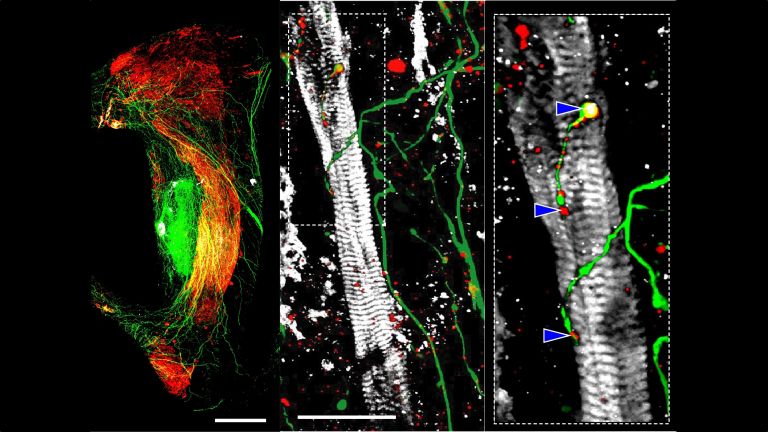
Researchers at the University Medical Center Göttingen (UMG) have gained new insights into the interaction between heart muscle cells and sympathetic nerve cells in a hereditary heart rhythm disorder. The findings were published in the journal "Nature Communications”.
Published: 23.10.2026
Heart palpitations when excited, a rapid pulse during exercise, or a pounding heart in stressful situations: The heartbeat constantly adapts to our surroundings and circumstances. For the heart to beat regularly, electrical signals in the heart muscle must be precisely coordinated. In some people, this process is disrupted due to a genetic mutation: After each heartbeat, the heart muscle takes longer to stabilize electrically. In stressful situations, this can trigger dangerous cardiac arrhythmias. One such condition is Long QT Syndrome Type 2 (LQT2).
A research team at the University Medical Center Göttingen (UMG) has now shown that in LQT2, not only are the heart muscle cells electrically altered, but sympathetic nerve cells—which accelerate the heart rate during physical or emotional stress, among other things—can also become overexcited. Their activity can further increase the heart’s susceptibility to arrhythmias.
The research team was led by Dr. Maria-Patapia Zafeiriou, who has held the Else Kröner Professorship for Disease Modeling at UMG since June 2026, with support from Prof. Dr. Wolfram-Hubertus Zimmermann, Director of the Institute of Pharmacology and Toxicology at UMG. The first authors of the study are Dr. Lennart Valentin Schneider, a former doctoral student, and Dr. Michael Gani Setya, a doctoral student at the Institute of Pharmacology and Toxicology at UMG.
The study in detail
In long QT syndrome, the electrical recovery of the heart muscle after each heartbeat is prolonged, which increases the risk of cardiac arrhythmias. The condition can have various genetic causes. In type 2 (LQT2), a potassium channel that helps terminate the electrical excitation of heart muscle cells is disrupted. Changes to such channels can also impair the function of nerve cells and, for example, contribute to epileptic seizures.
While the effects of the genetic mutation on the heart muscle are well understood, its impact on autonomic nerve cells—which, among other things, regulate the heartbeat—has remained unclear until now. Since emotional stress can trigger arrhythmias in LQT2, the researchers investigated whether the nerve cells that activate the heart during stress also contribute to their development.
Heart and nerve cells in a model
To investigate this question, the research team led by Dr. Schneider developed a human 3D model in which cardiac muscle cells and sympathetic nerve cells are interconnected. To do this, they generated both cell types from human stem cells and used them to develop three-dimensional tissue.
The nerve cells formed fine nerve fibers that grew into the heart muscle tissue and established contact with the heart muscle cells there. The researchers were also able to demonstrate that this connection functioned: When the nerve cells were selectively activated with light, the heart rate of the heart tissue changed.
The researchers then examined heart muscle and nerve cells with altered potassium channels. They found that the sympathetic nerve cells exhibited increased electrical excitability. Even when combined with healthy heart muscle cells, they could impair the electrical stability of the heart tissue. These results show that pathologically altered nerve cells can themselves contribute to the development of cardiac arrhythmias.
The effect of medications on electrical activity
The beta-blocker Propranolol was unable to prevent the abnormal electrical activity triggered by the activation of nerve cells. The active ingredient mexiletine, on the other hand, reduced it. It blocks sodium channels and thereby affects the electrical excitability of heart muscle and nerve cells.
Beta-blockers are part of the standard treatment for type 2 long QT syndrome. However, they do not provide adequate protection against cardiac arrhythmias for all affected individuals. The results provide evidence of additional mechanisms that may play a role in LQT2. Whether this will lead to new therapeutic approaches must be examined in further studies.
“The results provide a possible indication that, in cases of cardiac arrhythmias caused by altered potassium channels, not only the heart muscle but also the electrical excitability of nerve cells should be taken into account,” says Prof. Zafeiriou.
Propranolol
A medication for high blood pressure – a beta blocker. Beta blockers prevent the effects of adrenaline and noradrenaline.
A new model for heart research
The new model makes it possible to study heart muscle and nerve cells together and combine them in a targeted manner. This allows researchers to determine how altered heart muscle cells and altered nerve cells contribute to the development of cardiac arrhythmias.
“In the future, this model could help us better understand the interaction between the heart and the nervous system in other diseases and test new drugs in a human tissue model,” says Prof. Zafeiriou.
Original publication
Schneider LV et al.; Innervated human cardiac muscle model reveals sympathetic drivers of KCNH2-associated arrhythmias; Nature Communications (2026). DOI: https://doi.org/10.1038/s41467-026-76956-9
