New diagnostic markers for multiple sclerosis discovered in cerebrospinal fluid
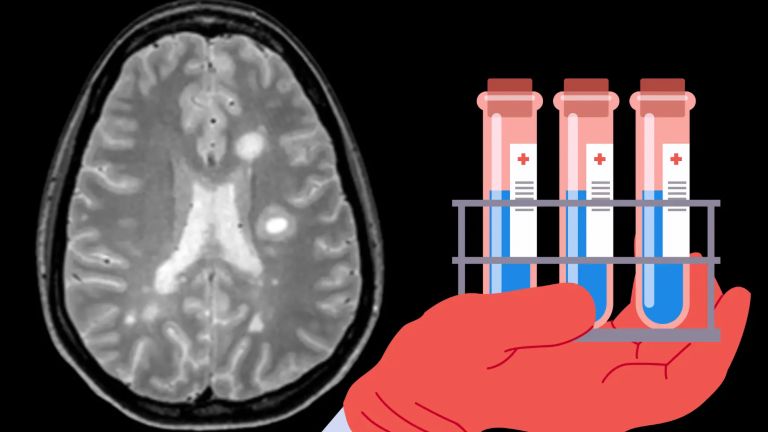
Researchers from the Max Planck Institute of Biochemistry and the Technical University of Munich (TUM) have discovered new diagnostic markers for multiple sclerosis (MS), a disease which affects 3 million people worldwide. Using mass spectrometry, about 1500 proteins were analyzed simultaneously per sample in the cerebrospinal fluid (CSF) of 5,000 patients. The study uncovered a set of marker proteins that improve differentiation of MS from other inflammatory brain diseases where classical MS markers are negative. Additionally, the study identified changes in the CSF proteome that may potentially predict disease progression. This approach could also open up new avenues for the diagnosis of other diseases.The study was published in Cell.
Published: 26.02.2026
- Unspecific neurological symptoms can lead to lengthy or even inaccurate diagnoses of diseases, which is why improved protein markers are needed for swift and clear diagnosis
- Using a new mass spectrometry method, approximately 1,500 proteins were analyzed per Cerebrospinal fluid sample across 5,000 patients, and up to 2,000 proteins in a further improved method
- A new set of disease markers enable improved differentiation of Multiple sclerosis (MS) from other inflammatory brain diseases, in particular for patients lacking the classical markers
- The proteome of the cerebrospinal fluid (CSF) at diagnosis is informative for various aspects of disease evolution in a patient, such as long-term disability, risk of conversion from relapsing to progressive disease course and time to conversion
- The method also has the potential to discover other proteins that could be used as markers for the diagnosis of other neurological diseases
Cerebrospinal fluid
liquor cerebrospinalis
A clear fluid that fills the ventricular system and bathes the brain and spinal cord in the subarachnoid space, protecting them from impact. Three to five times a day, 100 to 160 ml of fluid is renewed by the choroid plexus. Certain diseases are reflected in the composition of the cerebrospinal fluid.
Multiple sclerosis
encephalomyelitis disseminata
A common neurological disease that predominantly occurs in young adults. For reasons that are still unclear, the body's own cells attack and destroy the myelin sheaths of nerve cells. This can happen throughout the central nervous system, which is why two different multiple sclerosis patients can suffer from very different symptoms. Common symptoms include visual disturbances, numbness in the arms and legs, but also coordination problems, muscle weakness, and bladder problems.
Biomarker needs for multiple sclerosis
Imagine living with unexplained neurological symptoms: numbness, visual disturbances, fatigue, but not receiving a clear diagnosis for months or years. Non-specific neurological symptoms can make diagnosis difficult because, despite modern imaging techniques, there are no reliable molecular biomarkers for many neurological diseases.
Professor Bernhard Hemmer, head of the Department of Neurology at TUM University Hospital, explains: "The diagnosis of neurological diseases such as Multiple sclerosis is based on a combination of imaging techniques using Magnetic resonance imaging (MRI) and Cerebrospinal fluid (CSF) analysis. While MRI reveals inflammatory changes in the brain and spinal cord, CSF shows chronic immune activity in the nervous system. In most cases, this combination enables a reliable diagnosis. In individual cases, however, differentiation can be challenging. This can lead to lengthy and less reliable diagnoses and is associated with uncertain and delayed treatment decisions. For this reason, we need new biomarkers to better diagnose the various diseases. In addition to diagnostic challenges, predicting disease progression, particularly disability accumulation, to guide optimal treatment, remains a major unmet need in MS”.
Multiple sclerosis
encephalomyelitis disseminata
A common neurological disease that predominantly occurs in young adults. For reasons that are still unclear, the body's own cells attack and destroy the myelin sheaths of nerve cells. This can happen throughout the central nervous system, which is why two different multiple sclerosis patients can suffer from very different symptoms. Common symptoms include visual disturbances, numbness in the arms and legs, but also coordination problems, muscle weakness, and bladder problems.
Magnetic resonance imaging
Magnetic resonance imaging scanner
A device used by medical professionals for magnetic resonance imaging (MRI). MRI is an imaging technique used to diagnose malformations in various tissues or organs of the body. This method is particularly effective for imaging parts of the body that contain a lot of water. Patients are placed in a tube (scanner) and exposed to a strong magnetic field. However, they are not exposed to X-rays or other forms of ionizing radiation.
Cerebrospinal fluid
liquor cerebrospinalis
A clear fluid that fills the ventricular system and bathes the brain and spinal cord in the subarachnoid space, protecting them from impact. Three to five times a day, 100 to 160 ml of fluid is renewed by the choroid plexus. Certain diseases are reflected in the composition of the cerebrospinal fluid.
Proteomic study of cerebrospinal fluid across neurological diseases
In order to find new biomarkers, neurologists Bernhard Hemmer and Christiane Gasperi, both experts in MS research at TUM, have joined forces with Professor Matthias Mann, a world-leading expert in proteomics research. Matthias Mann, director at the MPI of Biochemistry, explains: "We have been developing the technology for measuring proteins using mass spectrometry in our laboratory together with colleagues for decades. Now we can reliably and accurately measure proteins in body fluids. However, for a long time researchers could only measure tens to hundreds of samples and only those proteins with the highest concentration in a body fluid. These proteins often turned out not to be the best markers for diseases. To go one step further, we combined the latest advances in mass spectrometry hardware, software, and sample preparation and adapted the workflow to cerebrospinal fluid."
In this study, CSF samples from more than 5,000 people with a wide range of neurological diseases were analyzed. Jakob Bader, first author of the study and postdoctoral researcher in the field of proteomics research, explains: "Proteomics is a scientific discipline that aims to characterize a biological system by measuring all proteins, or at least as many as possible. For our study, it is essential to cover as many proteins as possible in order to increase the likelihood of measuring and later finding real disease markers in our analyses. The great advantage of this proteomic approach is that the identity of the markers does not have to be known beforehand. This saves years of research work in which individual candidates are examined one after the other.”
To avoid misinterpreting random differences between people as disease markers, it is essential to have a sufficient number of patients. Similarly, it is only possible to determine whether a marker is specific to a particular disease by considering the many other relevant diseases in parallel. “The breakthrough was achieving both objectives simultaneously: Analyzing thousands of proteins while studying thousands of patients across many neurological diseases." Jakob Bader adds.
A systematic analysis of disease effects and possible confounders
The 5,000 CSF samples came from a wide range of neurological disorders, including stroke, brain cancer, infections, autoimmune diseases such as MS, and others. Additionally, patient samples were analyzed from individuals who had provided CSF samples for the diagnosis of severe headache disorders but in whom no neurological disease was found. This allowed the researchers to use these samples as controls. Systematic comparison of these disorders revealed shared and specific protein deviations from the controls.
For diagnostic use, an elevated protein concentration rarely points unambiguously to a single disorder. The study further revealed that disease-unspecific other effects like a person’s age, sex, and in particular degradation of the barriers insulating the brain from the CSF have a very large impact on the composition of this fluid, which complicates the quest for disease markers.
Biomarkers for a hard-to-identify form of multiple sclerosis
To showcase the potential of proteomic analysis for Biomarker discovery, the researchers focused on the search for diagnostic markers for MS, a challenging task but with a direct medical need. Physician Christiane Gasperi says: "In approximately 10% of MS patients, diagnosis of the disease is particularly difficult because they lack the typical MS marker of so-called oligoclonal bands of antibodies that are specific to the CSF and not found in the blood. This complicates and potentially delays the diagnosis.”
She continues: “However, for our patients, a quick and clear diagnosis of the disease is of enormous importance. While current therapies cannot cure MS, they can slow its progression and reduce the long-term disability. That makes it crucial to start treatment early. At the same time, these therapies can have significant side effects, so treatment decisions require a high level of diagnostic certainty. When this confidence is not reached yet, therapy is often delayed. Thus, MS patients really benefit from an early intervention that depends on a clear and early diagnosis."
To find better markers, the researchers applied an enhanced version of the proteomic method to measure about 2,000 proteins in samples of MS and other inflammatory diseases of the CNS, which can mimic MS, and thus pose the greatest diagnostic challenges. This let them identify a set of 22 proteins that distinguishes MS from these inflammatory diseases with better accuracy than other parameters in the CSF that are currently measured in clinical practice. Christiane Gasperi comments: “It is particularly encouraging that we have found a combination of marker proteins that help in the diagnosis of this particularly difficult-to-identify form of MS.”
Biomarker
In medicine, a biomarker is a substance that provides information about the physiological state of an organism. Biomarkers can either be produced in the body itself or describe chemical compounds that doctors introduce into the body to test certain physiological functions. Several indicators, for example, are being discussed as possible biomarkers for Alzheimer's disease. These include the concentration of soluble amyloid precursor protein in the blood and the activity of the enzyme that cleaves the precursor protein to produce plaque-forming beta-amyloid. Disease-related changes detected by imaging techniques are also often referred to as biomarkers. For example, the breakdown of brain tissue can be detected by MRI.
Predicting disease progression at diagnosis
Beyond improving diagnosis, the study also addressed a second major challenge: Some patients remain relatively stable for many years, while others accumulate disability more rapidly or transition from the relapsing disease course that is typical early on to a progressive course where disability accumulates persistently. At the time of diagnosis, it is very difficult to predict which Trajectory a patient will follow. This uncertainty complicates treatment decisions and can be deeply unsettling for those newly diagnosed.
By analyzing hundreds of MS patient samples, the researchers showed that the CSF proteome at the time of diagnosis was associated with the level of disability years later. In addition, these patterns reflected a higher risk for patients to convert from the relapsing to the progressive disease course, as well as shorter times until such conversion occurred. Bernhard Hemmer explains: “Our findings suggest that important aspects of future disability and disease course are reflected in the proteome from the very beginning. This demonstrates that the biological information required for a prognostic test is already present at diagnosis.”
He summaries the study: “For diagnosis, we were able to define and validate a focused protein panel that improves differentiation in difficult cases. Additionally, we found that the overall protein pattern in the CSF at the time of diagnosis is linked to how the disease develops years later. Together, these findings bring us closer to more precise diagnosis and a more individualized treatment strategy from the very beginning.
Trajectory
A physical term that describes the trajectory, or path, of an object – for example, a thrown object.
An avenue for efficient biomarker discovery in neurology
Matthias Mann sees broader potential: "Proteins control almost all biological processes in the body and have long been the most important group of diagnostic markers. Nevertheless, we are probably only at the beginning here. With the methodology established here, we can now analyze the proteome in the CSF of many patients with an unprecedented number of proteins. This technological progress changes how we should search for biomarkers. Comprehensive proteome analysis of large patient collectives promise to be the most efficient path to new and better biomarkers. Beyond MS, this approach opens up prospects for many other diseases of the central nervous system – from Alzheimer's and Parkinson's to brain tumors and other neurological disorders."
Original publication
Jakob M. Bader, Christine Makarov, Sabrina Richter, Maximilian T. Strauss, Friederike Held, Maria Wahle, Michael Baggio Lorenz, Lara Pöschl, Patricia Skowronek, Marvin Thielert, Achim Berthele, Wen-Feng Zeng, Constantin Ammar, Isabell Bludau, Benjamin Schubert, Fabian J. Theis, Christiane Gasperi, Bernhard Hemmer, Matthias Mann; Large-scale proteomics across neurological disorders uncovers Biomarker panel and targets in multiple sclerosis; Cell
Source
Biomarker
In medicine, a biomarker is a substance that provides information about the physiological state of an organism. Biomarkers can either be produced in the body itself or describe chemical compounds that doctors introduce into the body to test certain physiological functions. Several indicators, for example, are being discussed as possible biomarkers for Alzheimer's disease. These include the concentration of soluble amyloid precursor protein in the blood and the activity of the enzyme that cleaves the precursor protein to produce plaque-forming beta-amyloid. Disease-related changes detected by imaging techniques are also often referred to as biomarkers. For example, the breakdown of brain tissue can be detected by MRI.