Brain Possesses Greater Self-Repair Capacity than Previously Assumed
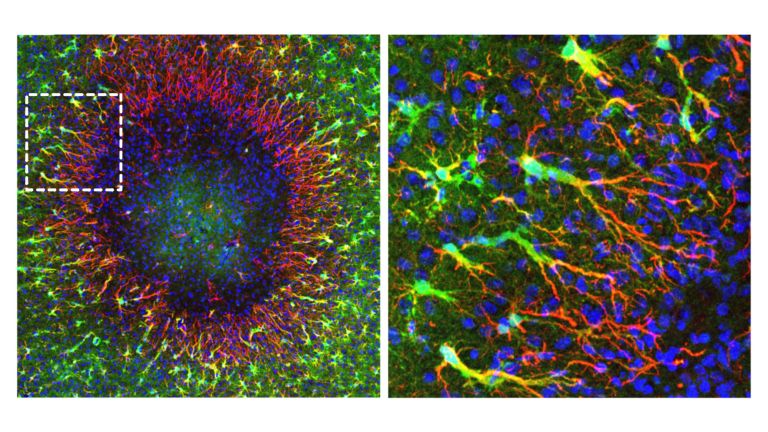
The brain evidently can regenerate itself better than previously assumed after injuries or certain autoimmune diseases. Using a mouse model, researchers at the University of Zurich have demonstrated that special supporting and nourishing cells repopulate damaged areas of the brain by initially sending only newly formed cell nuclei there.
Published: 10.08.2026
Glial cells
Glia cells are the second largest group of cells in the brain after neurons. For a long time, they were considered inactive elements of the brain, referred to as "nerve cement." Today, we know that the different types of glia cells (astrocytes, oligodendrocytes, and microglia in the CNS; Schwann cells in the PNS) perform clearly defined tasks in the nervous system. For example, they respond to pathogens, play an important role in nourishing nerve cells, and insulate nerve fibers. They account for slightly more than 50 percent of the brain's cells, compared to neurons.
Regenerative astrocytes repair damaged tissue
A new study by co-lead authors Marina Herwerth and Matthias Wyss from the Institute of Pharmacology and Toxicology at the University of Zurich (UZH) has now overturned that assumption: their research team headed by Bruno Weber discovered a specialized group of “regenerative” astrocytes in the brains of living mice that step in on the perimeter of the damaged area of the brain to rebuild the cells. “The findings of our study reveal a previously unknown ability of the adult brain to repair itself. They point toward new ways of supporting recovery from ailments involving the loss of astrocytes,” Weber says.
Only cell nuclei migrate
The researchers used two-photon microscopy to observe the brains of living mice in real time over a period of several weeks and mapped which genes switch on in which areas of the brain. This way they were able to identify the special astrocytes that take care of rebuilding injured tissue. But those cells don’t just divide, they also perform a remarkable feat: “they send the newly formed nuclei of their daughter cells gliding across long distances to repopulate the damaged area of the brain and knit the Astrocyte network back together,” Weber explains.
Astrocyte
astroglia
Astrocytes are among the largest glial cells. Their tasks include maintaining the blood-brain barrier and reabsorbing released neurotransmitters (messenger substances in the brain).
Starting points for targeted regeneration
The discovery of how adult brain cell nuclei migrate through the long star-shaped extensions of astrocytes to injured tissue expands comprehension of how the brain organizes and regenerates itself after certain injuries. If those mechanisms can be selectively activated, that could help to more effectively repair damaged brain tissue, restore Astrocyte networks and thus improve recovery after certain brain disorders. “We were able to identify numerous genes and signaling pathways that are temporarily activated during repair. They could serve as starting points in the future for influencing post-disease and -injury regeneration processes,” Weber stresses.
Astrocyte
astroglia
Astrocytes are among the largest glial cells. Their tasks include maintaining the blood-brain barrier and reabsorbing released neurotransmitters (messenger substances in the brain).
Original publication
Marina Herwerth*, Matthias T. Wyss*, et al. Focal Astrocyte loss reveals nuclear translocation during Lesion repopulation. Nature Neuroscience. 23 July 2026. DOI: 10.1038/s41593-026-02354-5 (*These authors contributed equally)
Astrocyte
astroglia
Astrocytes are among the largest glial cells. Their tasks include maintaining the blood-brain barrier and reabsorbing released neurotransmitters (messenger substances in the brain).
Lesion
A lesion is damage to organic tissue.