Search
-
- Glossary
Photoreceptors
Photoreceptors are the light-sensitive cells of the retina; they convert light into electrical potentials. There are approximately 127 million photoreceptors in the retina, including seven million cones and 120 million rods.
-
- News from the Institutes
How saccades enable mammals to simultaneously chase prey and navigate through complex environments
How do predators use their eyesight while pursuing their prey, which is running for its life, even in completely unclear terrain?
04.02.2025
-
- Glossary
Retina
The retina is the inner layer of the eye covered with pigment epithelium. The retina is characterized by an inverse (reversed) arrangement: light must first pass through several layers before it hits the photoreceptors (cones and rods). The signals from the photoreceptors are transmitted via the optic nerve to the processing areas of the brain. The reason for the inverse arrangement is the evolutionary development of the retina, which is a protrusion of the brain.The retina is approximately 0.2 to 0.5 mm thick.
-
- Basics
- Structure and Function
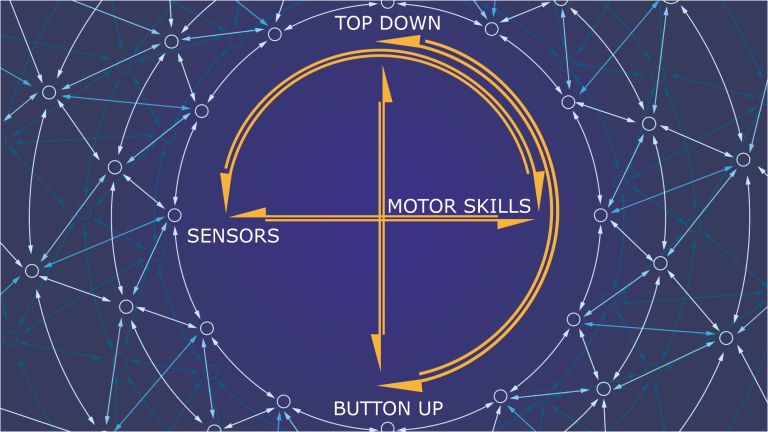
Senses and Actions
To prevent animals from bumping into one another, their sensory organs and motor skills are in constant communication.
18.12.2021
-
- News from the Institutes
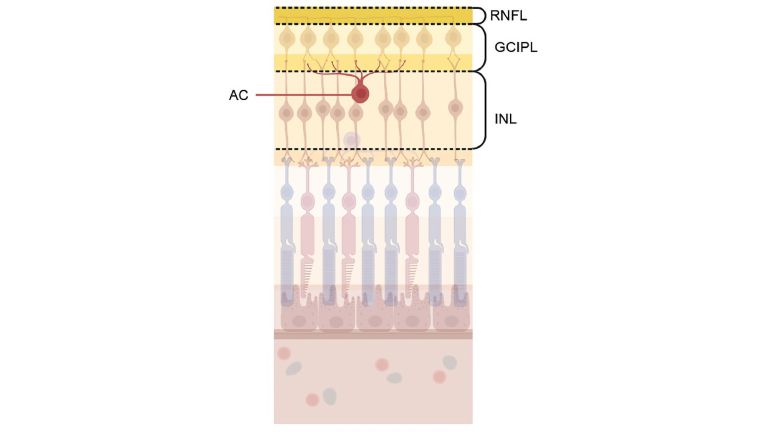
Insight into schizophrenia disease mechanisms found in the eye
Impaired neuronal connectivity in the retina
17.02.2025
-
- News from the Institutes
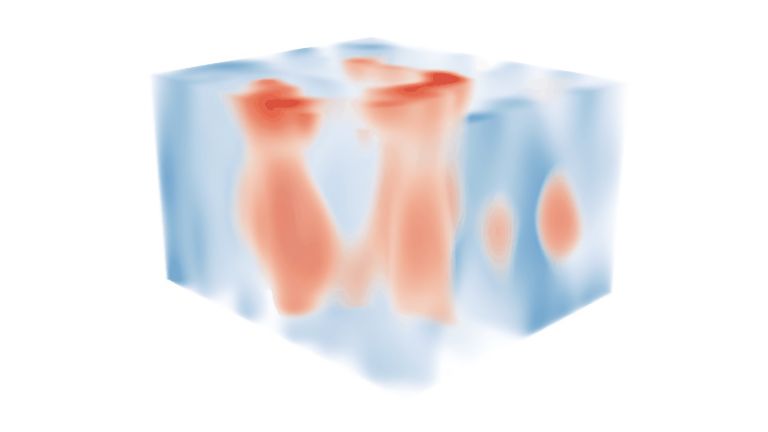
Neurons gather together for vision
As in larger brains, mouse visual cortex neurons with the same function cluster in columns
20.02.2025
-
- Basics
- Structure and Function
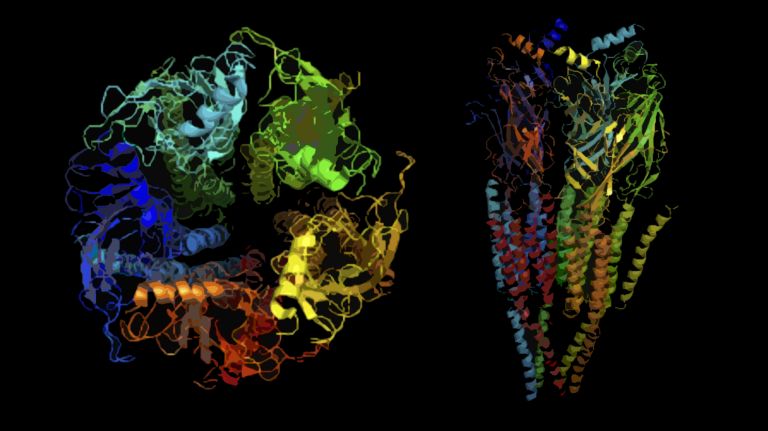
Communication Gaps: Ion Channels
Complex proteins span the membranes of nerve cells. Without these ion channels, literally nothing works.
01.12.2020
-
- Glossary
Adaptation
Adaptation refers to the process by which the sensory organs, the perceptual system, or the entire organism adjusts to the intensity and quality of stimuli and to changes in environmental conditions. In visual adaptation, for example, the pupil and the sensitivity of the photoreceptors regulate themselves according to the prevailing light conditions.
-
- Glossary
Amacrine cells
Amacrine cells are interneurons of the retina. They are located between photoreceptors and bipolar cells on the one hand and ganglion cells on the other. The name was coined by Ramón y Cajal and means "without axon."
-
- Glossary
Bipolar cells
The bipolar cell is a bipolar neuron, i.e., a neuron with one axon and one dendrite located in the middle layer of the retina. It transmits sensory information from the photoreceptors to the ganglion cells.