Search
-
- Basics
- Anatomy
The Epithalamus
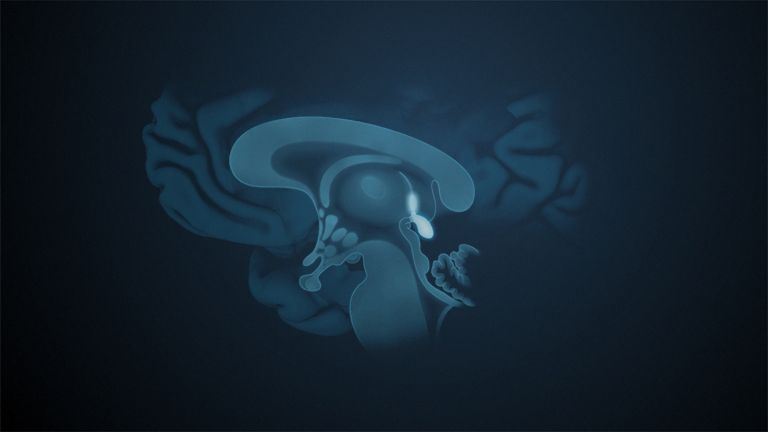
Probably not the seat of the soul after all: the pineal gland in the epithalamus.
09.10.2025
-
- Discover
- Milestones
Minds and Ideas
Science is made by people – people with histories, dreams, and mistakes.
26.09.2012
-
- Think
- Consciousness
When Consciousness fails
A complex system of brain structures is necessary for the conscious perception of our surroundings.
13.06.2025
-
- Glossary
Basal ganglia
The basal ganglia are a group of subcortical nuclei (located beneath the cerebral cortex) in the telencephalon. The basal ganglia include the globus pallidus and the striatum, and, depending on the author, other structures such as the substantia nigra and the subthalamic nucleus. The basal ganglia are primarily associated with voluntary motor function, but they also influence motivation, learning, and emotion.
-
- Glossary
CREB
A transcription factor in the cell nucleus that is activated by cAMP-dependent signaling pathways. CREB influences gene activity and can thus improve communication between two cells. This is a cellular basis for learning processes.
-
- Glossary
Extrapyramidal system
The extrapyramidal system refers to a series of structures in the brain that play a key role in influencing motor function but are not part of the pyramidal tract. It consists of multisynaptic neuron chains. The extrapyramidal system includes numerous nuclei such as the striatum, pallidum, nucleus ruber, and substantia nigra.
-
- Glossary
Climbing fiber
Climbing fibers are the axons (long fiber-like extensions of nerve cells) of neurons in the inferior olive nucleus of the brain stem. They extend into the cerebellum and "climb" along the Purkinje cells, with which they form synaptic connections.
-
- Glossary
Mesolimbic pathway
A system of neurons that use dopamine as a neurotransmitter and play a crucial role in emotion, reward, and substance abuse. The cell bodies are located in the subtegmental area and extend to the amygdala, the hippocampus, and – most importantly – the nucleus accumbens, where they have their terminal buttons.
-
- Glossary
Medial nuclei
The medial thalamic nuclei, especially the mediodorsal nucleus, are located in the medial thalamus and are closely connected to the prefrontal cortex and the limbic system. They are primarily responsible for higher cognitive functions such as planning, attention, and working memory, but are also involved in processing emotions and motivation. In addition, they integrate complex information from different areas of the brain.
-
- Glossary
Ventrolateral nuclei
The lower lateral nucleus group of the thalamus is responsible for motor function (movement). It receives inputs from the cerebellum and basal ganglia and has outputs to motor and premotor areas of the cerebral cortex.