Search
-
- Basics
- Anatomy
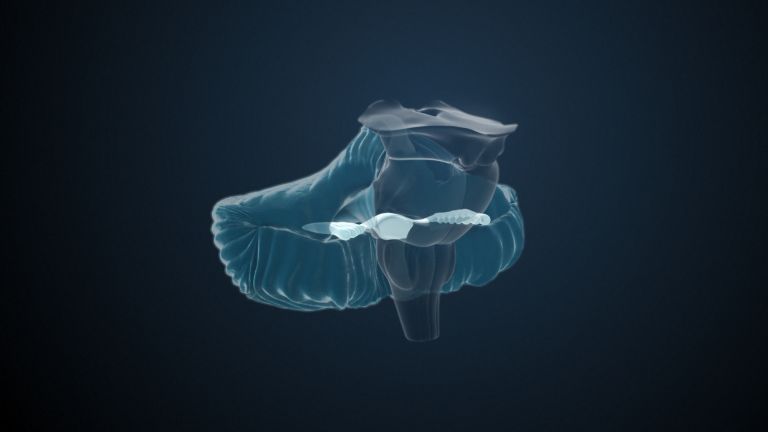
The Flocculonodular Lobe
The oldest part of the cerebellum is primarily concerned with balance.
05.08.2025
-
- Glossary
Cerebellum
The cerebellum is an important part of the brain, located at the back of the brain stem and below the occipital lobe. It consists of two cerebellar hemispheres covered by the cerebellar cortex and plays an important role in motor processes, among other things. It develops from the rhombencephalon.
-
- Percieve
- Hearing
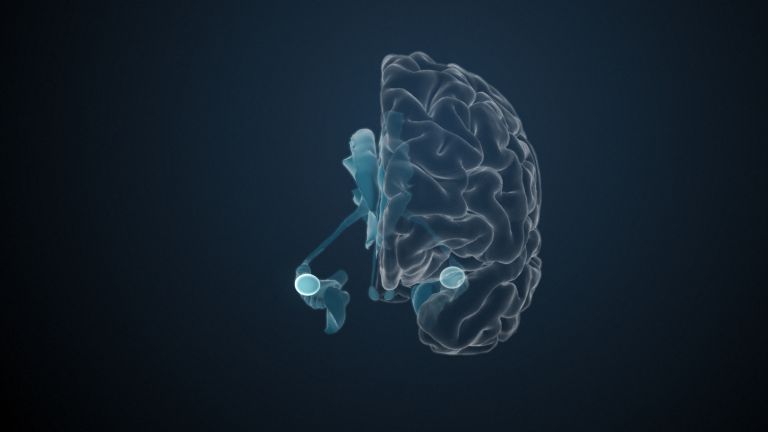
A Labyrinth for Balance
A sophisticated labyrinth in the ear keeps our body balanced: the vestibular system.
17.10.2025
-
- Basics
- Anatomy
The Amygdala
Without the amygdala, humans lose their sense of fear. With the amygdala, they also recognize the fear of others.
22.12.2023
-
- Diseases
- Multiple sclerosis
The Disease with a thousand Faces
Key facts about MS. And first things first: the course of the disease can be significantly influenced.
07.10.2025
-
- Glossary
Inferior colliculus
Two posterior elevations of the midbrain roof are referred to as the inferior colliculi. Together with the superior colliculi, they form the midbrain tectum. Impulses from various nuclei of the lower brain stem converge at the inferior colliculi. In addition, signals from the auditory cortex arrive here. This makes the inferior colliculi an important coordination center for auditory information.
-
- Glossary
Olivary bodies
The olivary bodies are two oval structures in the lower part of the brain stem that contain clusters of nerve cell bodies. The lower olive connects the cerebrum to the cerebellum and plays an important role in controlling motor function. The upper olive is part of the auditory pathway. Its neurons can evaluate differences in transit time and level between the right and left ears, thus helping to determine the direction of sound sources.
-
- Glossary
Climbing fiber
Climbing fibers are the axons (long fiber-like extensions of nerve cells) of neurons in the inferior olive nucleus of the brain stem. They extend into the cerebellum and "climb" along the Purkinje cells, with which they form synaptic connections.
-
- Glossary
Lewy body dementia
A neurodegenerative disease that resembles Alzheimer's disease, but also Parkinson's disease in its symptoms. The Lewy bodies that give the disease its name are caused by protein deposits in the nerve cells of the cerebral cortex and brain stem, which impair the function of the corresponding neurons. In addition to cognitive impairment, Lewy body dementia often causes hallucinations or depression, as well as changes in mobility similar to those seen in Parkinson's disease.
-
- Glossary
Ventral tegmental area
Located in the midbrain, the uppermost section of the brain stem, is the ventral tegmental area (VTA) – a central component of the reward system. The area itself is not particularly large, but its influence is immense: the neurons of the VTA send their axons to the nucleus accumbens and widely into the prefrontal cortex (PFC), where they release the neuromodulator dopamine. In this way, they enhance learning processes, but can also contribute to the development of addictions.