Search
-
- Glossary
Dura mater
The outermost of the three membranes covering the brain and spinal cord. Consists of connective tissue.
-
- Glossary
Periaqueductal gray
A core area in the brain stem that is involved in defensive behavior and fear and flight reflexes via close connections to the limbic system. It also plays an important role in pain suppression by regulating signals from the spinal cord to the brain. It is considered an endogenous pain control system and is an important target for medication.
-
- Basics
- Anatomy
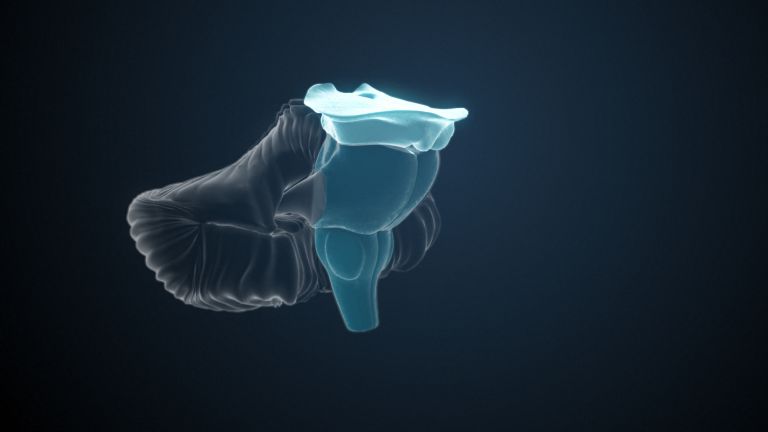
The Mesencephalon
Important neurotransmitters, an astonishing array of colors, and a water pipe – that's the midbrain.
20.09.2025
-
- Glossary
dorsal
The positional term dorsal means "towards the back." In relation to the nervous system, it refers to a direction perpendicular to the neural axis, i.e., upwards towards the head or backwards.In animals that do not walk upright, the term is simpler, as it always means toward the back. Due to the upright posture of humans, the brain bends in relation to the spinal cord, making dorsal mean "upward."
-
- Glossary
Pons
Area in the brain stem between the medulla oblongata and the mesencephalon. It acts as a switching station for many nerve pathways between the brain and spinal cord and contains numerous nuclei, including cranial nerves and those involved in controlling motor function in cooperation with the cerebellum.
-
- Glossary
ventral
A positional term – ventral means "towards the abdomen." In relation to the nervous system, it refers to a direction perpendicular to the neural axis, i.e., downwards or forwards. In animals (that do not walk upright), the term is simpler, as it always means toward the abdomen. Due to the upright posture of humans, the brain bends in relation to the spinal cord, making ventral mean "forward."
-
- Glossary
Posterior ventral nucleus
A nucleus of the dorsal thalamus that serves as the main somatosensory thalamic nucleus. The VPL receives somatosensory afferents from the body via the spinal cord (pressure, touch, vibration, proprioception, pain, temperature), while the VPM receives afferents from the head region via the trigeminal nerve. It transmits this information to the primary somatosensory cortex (S1) and thus plays a central role in the awareness of somatosensory stimuli, including pain.
-
- Glossary
Substance P
Substance P is a neuropeptide that acts as a neurotransmitter and belongs to the tachykinin family. High concentrations are found in the dorsal horn of the spinal cord, where it is involved in pain modulation.
-
- Glossary
Cerebrospinal fluid
A clear fluid that fills the ventricular system and bathes the brain and spinal cord in the subarachnoid space, protecting them from impact. Three to five times a day, 100 to 160 ml of fluid is renewed by the choroid plexus. Certain diseases are reflected in the composition of the cerebrospinal fluid.
-
- Glossary
Mossy fiber
Mossy fibers are nerve fibers that conduct impulses from the spinal cord and the pontine nuclei to the cerebellum. There they terminate in the granule cell layer. The axons of the granule cells of the dentate gyrus in the hippocampus, which extend to CA3, are also referred to as mossy fibers.