Search
-
- Think
- Emotions
Conscious Emotions
We only consciously feel fear, disgust, love, and hate when the cerebral cortex is engaged.
11.08.2025
-
- Think
- Consciousness
Playing Tennis in a vegetative State
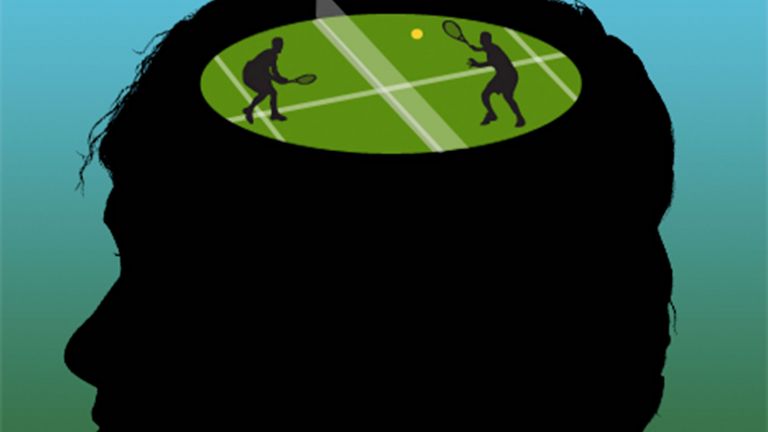
Adrian Owen and colleagues use brain scans to search for the hidden minds of coma patients.
12.06.2025
-
- News
- Question to the brain
Why do we get Headaches?
The brain has no pain receptors. So why do we still get headaches?
14.10.2025
-
- Topic
Vision
About 80 percent of the information about the environment comes from our eyes. A good quarter of the brain is involved in processing this input.
-
- Glossary
Accommodation
Change in the thickness of the lens of the eye by the ciliary muscles. This adjustment process increases the refractive power of the lens, allowing objects at different distances to be seen clearly.
-
- Glossary
Eyeball layers
The layers of the eye form the wall of the eyeball. They can be roughly divided into three areas: the outer membrane with the cornea and sclera, the middle membrane with the iris, choroid, and ciliary body, and the inner membrane with the photoreceptive and blind parts of the retina.
-
- Glossary
Cornea
The cornea is the transparent front part of the outer layer of the eye. It is involved in refracting light, ensuring that the image of a distant object falls on the point of sharpest vision on the retina.
-
- Glossary
Convergence
Convergence of neurons occurs when several neurons are connected synaptically to a single transmitting neuron. In the eye, for example, information received by up to 130 receptors is transmitted to only one neuron in the retina. The opposite is divergence, when one neuron transmits signals to several other neurons.
-
- Glossary
Lens
The eye lens is a transparent, flexible structure which, thanks to its varying degree of curvature (see ciliary muscle and zonular fibers), enables the process of accommodation (focusing) and thus sharp vision at different distances, especially at close range.
-
- Glossary
Flocculonodular lobe
The flocculonodular lobe is an antero-inferior region of the cerebellum. It comprises two structures, the nodulus (nodule) and the flocculus (flocculus). It is involved in balance and spatial orientation, as well as in stabilizing and controlling eye movements. It corresponds to the vestibulocerebellum.