Search
-
- Diseases
- Alzheimer's disease
The Challenge of Caring for Dementia Patients
More and more people are suffering from dementia – a challenge for hospitals.
11.01.2012
-
- Page
The Project
24.02.2017
-
- Topic
Basic Research
Basic research is aimless. But eminently important.
-
- Glossary
Neurofibrils
Neurofibrils are fine fibrous structures in nerve cells that consist mainly of neurofilaments (a form of intermediate filaments) and other components of the cytoskeleton. They run in bundles through the cell body and the extensions of neurons and contribute significantly to the stabilization and shaping of the nerve cell. They appear as characteristic features of neurons even in the early embryo. Alzheimer's disease causes profound changes in cytoskeletal structures: the protein tau, which normally stabilizes microtubules, becomes excessively phosphorylated, detaches from the microtubules, and aggregates to form the typical neurofibrillary tangles (fibrillary bundles). These are a central pathological feature of the disease.
-
- News from the Institutes
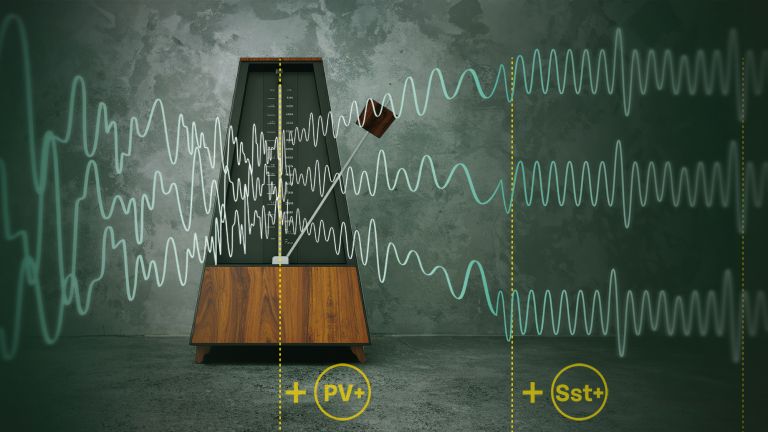
Interaction between interneurons stabilizes gamma oscillations in a brain
PV+ cells act as the “conductors” of visually induced gamma oscillatory rhythm
26.05.2025
-
- Glossary
Dementia
Dementia is an acquired deficit of cognitive, social, motor, and emotional abilities. The most well-known form is Alzheimer's disease. "De mentia" means "without mind" in English.
-
- Glossary
Biomarker
In medicine, a biomarker is a substance that provides information about the physiological state of an organism. Biomarkers can either be produced in the body itself or describe chemical compounds that doctors introduce into the body to test certain physiological functions. Several indicators, for example, are being discussed as possible biomarkers for Alzheimer's disease. These include the concentration of soluble amyloid precursor protein in the blood and the activity of the enzyme that cleaves the precursor protein to produce plaque-forming beta-amyloid. Disease-related changes detected by imaging techniques are also often referred to as biomarkers. For example, the breakdown of brain tissue can be detected by MRI.
-
- Glossary
Plaques
Senile plaques accumulate in the gray matter of the brain when a protein – known as amyloid precursor protein – is not broken down correctly. Inflammation and disorders of fat or sugar metabolism can promote plaque formation. On average, the deposits reach a diameter of 50 micrometers. The appearance of plaques is one of several anatomical changes in the brain that pathologists can use to diagnose Alzheimer's disease after death.
-
- Glossary
Beta-amyloid
A peptide consisting of 36 to 42 amino acids that is considered the main component of senile plaques and is believed to be responsible for the development of Alzheimer's disease. The starting product is the amyloid precursor protein (APP). Certain enzymes in the cell membrane cut the precursor protein into peptides of various sizes. Amyloids consisting of 40 and 42 amino acids are found in senile plaques, with the 42-amino-acid product forming aggregates particularly quickly, at least in the Petri dish. The normal function of beta-amyloid has not yet been conclusively clarified.
-
- Glossary
Oligomer
Chemists define an oligomer as a molecule composed of several structurally similar or identical units. Typically, an oligomer consists of a few monomers (e.g., 2–10, occasionally up to about 30). An example from biochemistry is collagen, which is composed of three identical polypeptide chains and occurs as a trimeric protein in connective tissue. If the number of building blocks significantly exceeds this range, as is the case with DNA, it is referred to as a polymer. Oligomers of beta-amyloid may play an important role in the development of Alzheimer's disease.