Search
-
- Basics
- Communication of Cells
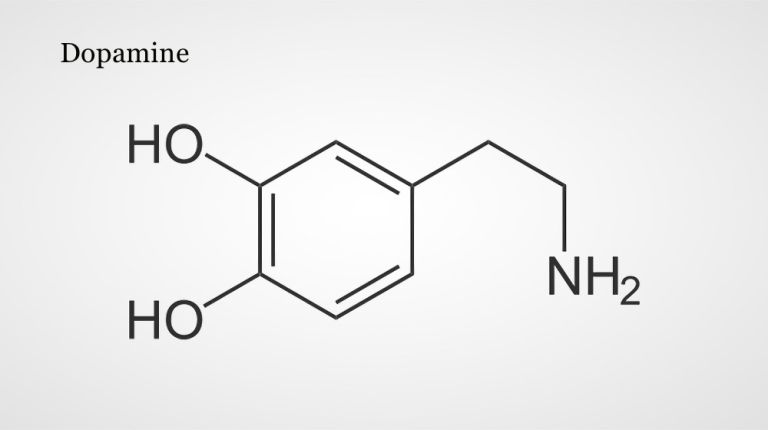
Dopamine
As a neurotransmitter, dopamine also plays a role in the reward center.
07.05.2012
-
- Glossary
Acetylcholine
Acetylcholine is one of the most important neurotransmitters in the nervous system. In the central nervous system, it is involved in attention, learning, and memory; in the peripheral nervous system, it transmits excitation from nerves to muscles at the neuromuscular end plates and controls processes of the autonomic nervous system, i.e., the sympathetic and parasympathetic parts. Areas in which acetylcholine acts as a messenger substance are called cholinergic. It was the first neurotransmitter to be discovered, identified in 1921 by Otto Loewi in the heart of a frog.
-
- Glossary
Adrenaline
Along with dopamine and norepinephrine, it belongs to the catecholamines. Adrenaline, also known as epinephrine, is the classic stress hormone. It is produced in the adrenal medulla and causes an increase in heart rate and heartbeat strength, thus preparing the body for increased stress. In the brain, adrenaline also acts as a neurotransmitter (messenger substance), where it binds to so-called adrenoreceptors.
-
- Glossary
cholinergic
Cholinergic neurons produce acetylcholine (an important neurotransmitter in the brain), and cholinergic synapses use it to transmit signals.
-
- Glossary
Dopamine
Dopamine is an important neurotransmitter in the central nervous system that belongs to the catecholamine group. It plays a role in motor function, motivation, emotion, and cognitive processes. Disruptions in the function of this transmitter play a role in many brain disorders, such as schizophrenia, depression, Parkinson's disease, and substance dependence.
-
- Glossary
Extinction
In extinction, a previously conditioned stimulus is presented several times without the originally paired reinforcement until the conditioned response subsides. For example, a dog has learned that the ringing of a bell announces food (conditioned stimulus → conditioned salivation response). In extinction, the bell is now rung several times without food following. After a few repetitions, the dog stops drooling when the bell rings: the conditioned response subsides. This decrease in response can also be detected at the synaptic level, for example, by a reduction in neurotransmitter release.
-
- Glossary
GABA
GABA is an amino acid and the most important inhibitory neurotransmitter, which acts as a messenger in the transmission of information between neurons at their synapses.
-
- Glossary
Glutamate
Glutamate is an amino acid and the most important excitatory neurotransmitter, which acts as a messenger substance in the transmission of information between neurons at their synapses.
-
- Glossary
Inhibition
Neuronal inhibition describes the phenomenon whereby a sender neuron sends an impulse to a receiver neuron, causing the latter's activity to decrease. The most important inhibitory neurotransmitter is GABA.
-
- Glossary
Mesolimbic pathway
A system of neurons that use dopamine as a neurotransmitter and play a crucial role in emotion, reward, and substance abuse. The cell bodies are located in the subtegmental area and extend to the amygdala, the hippocampus, and – most importantly – the nucleus accumbens, where they have their terminal buttons.