Search
-
- Glossary
Complex cell
A nerve cell in the primary visual cortex with large receptive fields. They respond to visual stimuli with appropriate contrast, a specific orientation, and often also a specific direction of movement.
-
- Glossary
Operculum
Cortical areas of the frontal, temporal, and parietal lobes at the lateral sulcus. The operculum covers the insular cortex.
-
- Glossary
Inferior olivary nucleus
The inferior olive – more precisely, the olive nucleus complex – is one of the largest nucleus complexes in the brain stem. It plays an important role in fine-tuning motor skills, as it forms the connection between the motor cortex and the cerebellum.
-
- Glossary
Betz giant cells
Betz giant cells are particularly large pyramidal cells in the primary motor cortex (area 4). They have very large cell bodies with a diameter of 100 µm and heavily myelinated axons that project directly into the spinal cord. This makes them part of the corticospinal neurons of the pyramidal tract. Although they make up only a small portion of the fibers of the pyramidal tract, they are functionally important for the control of voluntary movements, especially fine motor skills.
-
- Glossary
Plasticity
The term neuroplasticity describes the ability of synapses, nerve cells, and entire areas of the brain to change structurally and functionally depending on the degree to which they are used. Synaptic plasticity refers to the adaptation of the signal transmission strength of synapses to the frequency and intensity of incoming stimuli, for example in the form of long-term potentiation or depression. In addition, the size, interconnection, and activity patterns of different areas of the brain also change depending on their use. This phenomenon is referred to as cortical plasticity when it specifically affects the cortex.
-
- Glossary
Visual radiation
The optic radiation – also known as Gratiolet's optic radiation after its discoverer – distributes visual impulses from the lateral geniculate nucleus to the comparatively very large primary visual cortex.
-
- Basics
- Anatomy
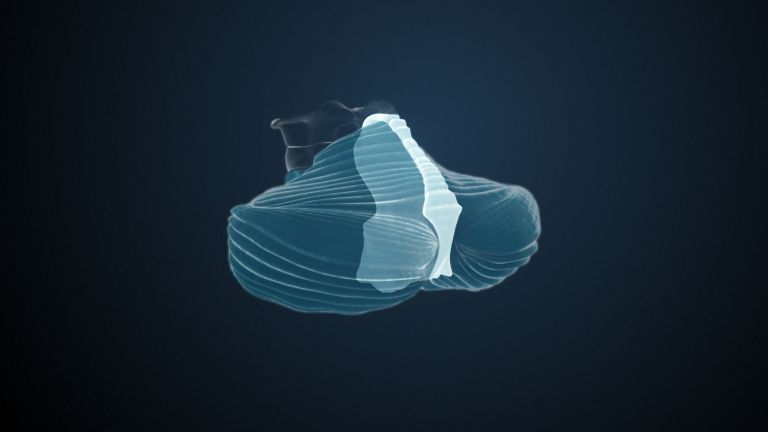
The Vermis
The worm in our heads, inlcuding a tongue, pyramid, and more. But it's a good one, helping us walk.
01.10.2025
-
- Glossary
Caudate nucleus
Part of the basal ganglia, it forms the striatum together with the putamen. Anatomically, the caudate nucleus is located frontally in the center of the brain and extends backward, forming a C shape. It consists of a head (caput nuclei caudati), a body (corpus nuclei caudati), and a tail (cauda nuclei caudati). In contrast to the more motor-related parts of the basal ganglia, this area is strongly connected to the prefrontal cortex in addition to its motor functions. As a result, this part of the striatum is also heavily involved in cognition, motivation, and emotion.
-
- Glossary
Supplementary motor area
Area of the association motor cortex in the frontal lobe that is involved in movement planning and the organization of movement sequences.
-
- Glossary
Cortisol
A hormone produced by the adrenal cortex that is primarily an important stress hormone. It belongs to the group of glucocorticoids and influences carbohydrate and protein metabolism in the body, suppresses the immune system, and acts directly on certain neurons in the central nervous system.