Search
-
- Glossary
Inferior colliculus
Two posterior elevations of the midbrain roof are referred to as the inferior colliculi. Together with the superior colliculi, they form the midbrain tectum. Impulses from various nuclei of the lower brain stem converge at the inferior colliculi. In addition, signals from the auditory cortex arrive here. This makes the inferior colliculi an important coordination center for auditory information.
-
- Glossary
Mamillary bodies
Two structures of the posterior thalamus (largest part of the diencephalon). Due to their similarity to the female breast, they are also called mammillary bodies. They are located at the front end of the fornix and are attributed to the limbic system.
-
- Glossary
Parahippocampal gyrus
The parahippocampal gyrus runs along the hippocampus in the lower, inner temporal lobe. Its anterior part is covered by the entorhinal cortex. It is connected to numerous areas of the cerebral cortex and projects to the hippocampus, which it also acts as a gateway to. This means that it is involved in the consolidation of explicit memory content, among other things. In addition, the posterior part of the parahippocampal gyrus contains the parahippocampal place area (PPA), which responds particularly to complex visual scenes such as rooms, landscapes, or streets and thus plays an important role in spatial orientation and location recognition.
-
- Glossary
Hypophysis
The pituitary gland is an important hormone gland in the body. It hangs like a drop below the hypothalamus and is no larger than a pea. The pituitary gland consists of two parts, the anterior lobe (adenohypophysis) and the posterior lobe (neurohypophysis). The anterior lobe of the pituitary gland has the special property of being partially exempt from the blood-brain barrier, allowing it to release hormones directly into the blood.
-
- Glossary
Orbitofrontal cortex
A convolution in the orbitofrontal cortex of the cerebral cortex, located anatomically behind the eyes. The orbitofrontal cortex plays a crucial role in decision-making and monitoring social interactions and is correspondingly complex in structure. It consists of four different substructures: the medial, lateral, anterior, and posterior orbital gyri, as well as the rectus gyrus.
-
- Glossary
Oxytocin
Oxytocin is a hormone produced in the paraventricular nucleus and supraoptic nucleus of the hypothalamus and released into the blood via the posterior lobe of the pituitary gland. It initiates contractions during childbirth and supports the milk ejection reflex during breastfeeding. It is also released during orgasm. Oxytocin can promote trust and strengthen pair bonding, but recent findings show that its effects are more complex and, in certain contexts, can also promote separation from out-groups.
-
- Glossary
Parietal lobe
The parietal lobe is one of the four large lobes of the cerebral cortex. It is located behind the frontal lobe and above the occipital lobe. Somatosensory processes take place in its anterior region, while sensory information is integrated in its posterior region, enabling the handling of objects and spatial orientation. In addition, the parietal lobe is involved in attention, the recognition of body parts and objects, as well as linguistic and mathematical abilities.
-
- Glossary
Pulvinar
The pulvinar is a fairly large nucleus in the posterior thalamus that is connected to many visual centers. It appears to increase the excitability of cells in the visual cortex as soon as a stimulus is noticed. Some studies suggest that the pulvinar may also indirectly support language processing via cortical connections.
-
- Glossary
Temporo-parietal junction
The transition between the temporal and parietal lobes – i.e., the temporal and parietal lobes – of the cerebral cortex. Here, in the posterior region of the Sylvian fissure, information from the limbic system, the thalamus, and the visual, auditory, and somatosensory cortex is integrated. Accordingly, the temporo-parietal junction forms an anatomical and functional hub of the brain that helps us develop complex abilities, including the ability to recognize biological movement or the ability to empathize with other people.
-
- Basics
- The Developing Brain
The invisible Bond
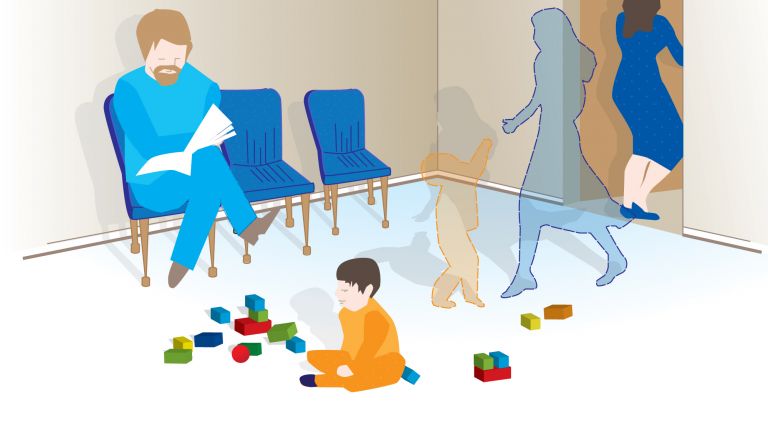
Emotional bond – the essential connection between children and parents.
18.03.2026