Search
-
- Percieve
- Hearing
Hearing: The Cochlea
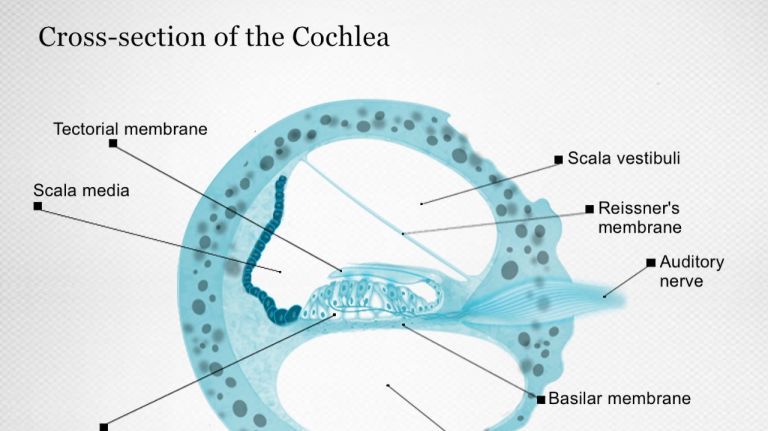
The inner ear contains a spiral structure that is very important for hearing: the cochlea.
23.10.2025
-
- Topic
Pain
Pain – considered by the ancient Greeks to be the “barking watchdog of health” – spans all scales of the nervous system.
-
- Glossary
Anvil
The middle of the three ossicles in the middle ear transmits the vibration from the malleus to the stapes.
-
- Glossary
Cochlea
The cochlea is the part of the inner ear that contains the organ of Corti, which is responsible for converting acoustic signals into nerve impulses.
-
- Glossary
Corti’s organ
The organ of Corti is part of the cochlea (hearing organ) in the inner ear. Here, sound waves are picked up by hair cells and converted into nerve impulses.
-
- Glossary
Ossicles
The three bones located in the middle ear – the stapes, malleus, and incus – are known as the ossicles. These are the smallest bones in the human body. They mechanically transmit sound waves from the eardrum to the cochlea.
-
- Glossary
Hair cells
Sensory cells in the inner ear located in the organ of Corti and the semicircular canals. The hair cells in the organ of Corti are responsible for transducing (converting) the vibrations into electrical potentials. Each of these sensory cells has hair-like protrusions of varying lengths, called stereocilia. These are interconnected. The movement of these stereocilia caused by the vibrations is the key to signal transduction in the hair cells.
-
- Glossary
Hammer
The first of the small ossicles in the middle ear. It is connected to the eardrum and transmits the vibrations caused by sound waves via the other two ossicles (incus, stapes) to the cochlea, where the stimulus is converted into a neural signal.
-
- Glossary
Auditory pathway
The auditory pathway refers to the nerve fibers that transmit acoustic information from the inner ear to the primary auditory cortex. In humans, the auditory pathway consists of five switching points: the spiral ganglion, the auditory nuclei in the brainstem, the inferior colliculus, the medial geniculate body of the thalamus, and the primary auditory cortex.
-
- Glossary
Auditory nerve
The hair cells of the organ of Corti stimulate neurons in the spiral ganglion, which is located in the cavity of the cochlea. Their axons form the auditory nerve, which transmits electrical impulses from the inner ear to the brain. Together with the vestibular nerve (nervus vestibularis), the auditory nerve forms the VIII cranial nerve.