Search
-
- Basics
- Communication of Cells
Neurotransmitters: Messenger Molecules in the Brain
“Happy hormone” & Co.: Without neurotransmitters, nerve cells would not be able to communicate.
05.08.2025
-
- Discover
- Milestones
John Eccles: Across the Gap
John Eccles disproved his own theories. In doing so, he helped to elucidate synaptic transmission.
06.06.2013
-
- News from the Institutes
AI looks deeper into visual system
Artificial intelligence models provide insights to understand the processing of visual stimuli in the brain
10.04.2025
-
- Glossary
Dendritic spines
Mushroom- or button-shaped protrusions on dendrites, at the tip of which there is usually a synapse, which is the site of communication between two nerve cells. The spines increase the surface area of dendrites, which thus have space for additional synapses. They play an important role in synaptic plasticity. The dendritic spines can swell and shrink depending on activation.
-
- Glossary
Terminal button
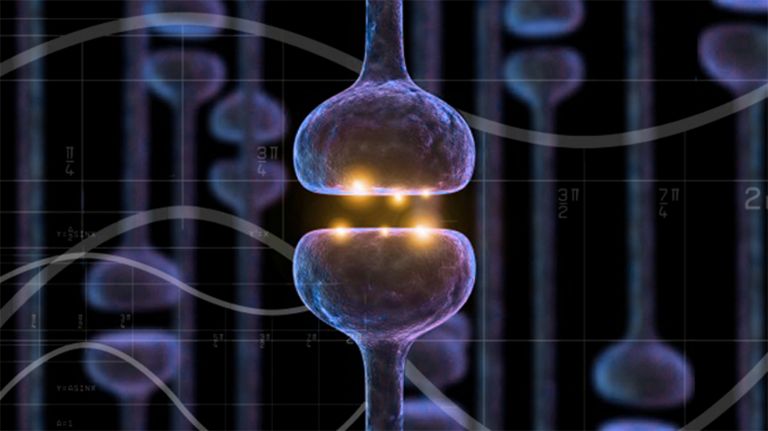
The end of an axon (long, fiber-like extension) of a nerve cell is called a terminal bouton if it is the presynaptic part of a synapse. The terminal bouton is a spherical thickening containing vesicles (small sacs) that store neurotransmitters (chemical messengers in the brain).
-
- Glossary
excitatory
Exciting synapses are described as excitatory when they depolarize the subsequent cell membrane and can thus lead to the formation of an action potential. An excitatory effect is usually produced by an exciting transmitter (messenger substance), such as glutamate. The opposite is an inhibitory synapse.
-
- Glossary
Gliotransmitter
Chemical messengers released by astrocytes and other glial cells. They enable glial cells to communicate with other cells in the nervous system, for example when forming a synapse. The most common types of gliotransmitters are the amino acids glutamate and D-serine, as well as adenosine triphosphate (ATP).
-
- Glossary
Alzheimer's disease
Alzheimer's disease is a progressive neurodegenerative disorder characterized by cortical atrophy, nerve cell loss, synapse loss, and deposits of amyloid plaques and neurofibrillary tangles, leading to dementia and loss of function. Early symptoms include memory problems, speech disorders, executive deficits, depressive moods, and subtle personality changes. As the disease progresses, global cognitive impairment, aphasia, agnosia, apraxia, and behavioral abnormalities such as apathy, restlessness, and sleep disorders occur. The disease was first described in 1907 by Alois Alzheimer.
-
- Glossary
Lock and key
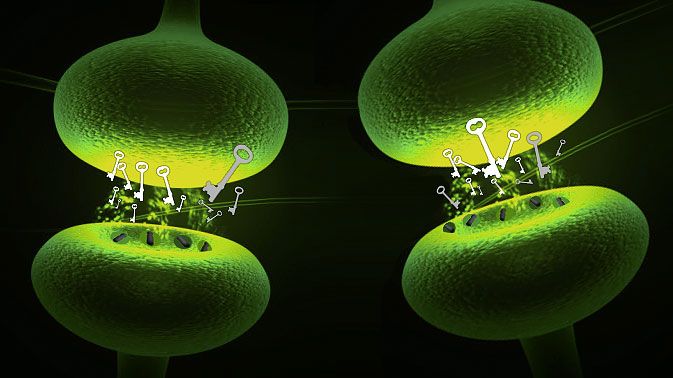
In terms of the processes in a synapse, this means that the chemical messenger and its receptor must fit together like a key in a lock. The receptor therefore only "accepts" a very specific messenger.
-
- Glossary
Synaptic depression
Weakening of signal transmission at a synapse due to reduced neurotransmitter release or decreased receptor sensitivity; occurs, for example, with repeated stimulation (habituation).