Search
-
- Glossary
Posterior ventral nucleus
A nucleus of the dorsal thalamus that serves as the main somatosensory thalamic nucleus. The VPL receives somatosensory afferents from the body via the spinal cord (pressure, touch, vibration, proprioception, pain, temperature), while the VPM receives afferents from the head region via the trigeminal nerve. It transmits this information to the primary somatosensory cortex (S1) and thus plays a central role in the awareness of somatosensory stimuli, including pain.
-
- Basics
- Anatomy
The Medulla Oblongata
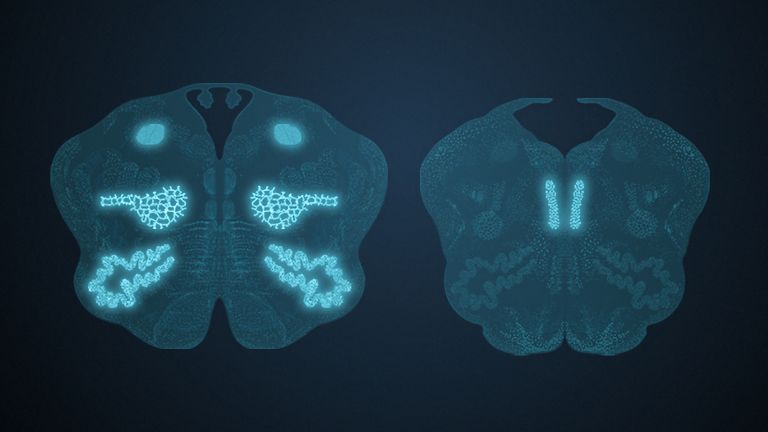
Fibers and nuclei – and important nuclei at that. The medulla oblongata is where the brain begins.
01.10.2025
-
- Basics
- Anatomy
The Striatum
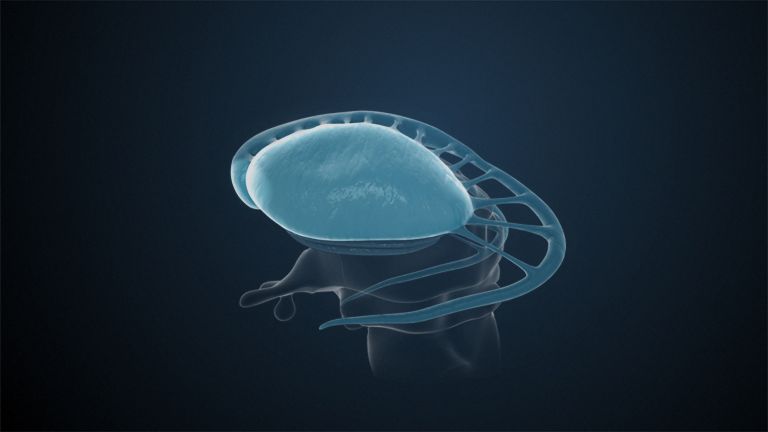
The striatum is not only about complex motor skills, but also about happiness.
28.11.2025
-
- Basics
- Structure and Function
The Wonders of Life
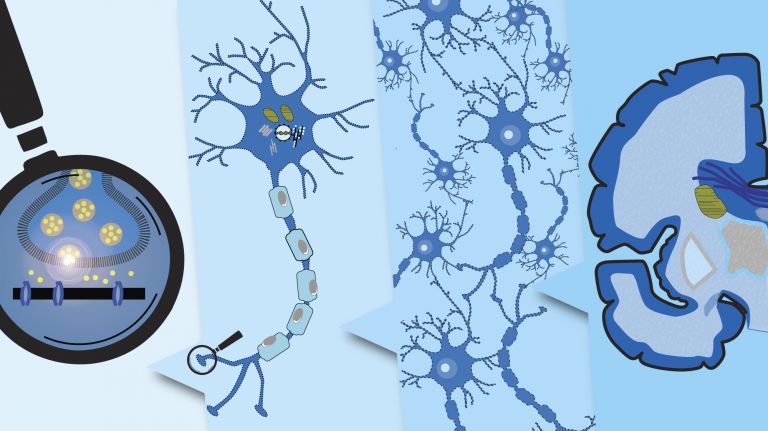
Researchers are examining life in ever greater detail. It is revealed to be intricate and complex – the miracle becomes explainable. Yet this in no way diminishes it.
30.04.2020
-
- Glossary
Medial geniculate nucleus
The medial geniculate nucleus (medial geniculate body) is a nucleus of the thalamus (the largest part of the diencephalon). As the central switching point of the auditory pathway, it transmits impulses from the inferior colliculus to the auditory radiation. Together with the lateral geniculate body, it forms the metathalamus.
-
- Glossary
Nucleus
Nucleus, plural nuclei, has two meanings: in cell biology, it refers to the cell nucleus, which contains chromosomes, among other things. In neuroanatomy, it refers to a collection of cell bodies in the nervous system – in the central nervous system as gray matter, in the peripheral nervous system as ganglia.
-
- Glossary
Nucleus accumbens
The nucleus accumbens is a nucleus in the basal ganglia that receives dopaminergic (dopamine-responsive) inputs from the ventral tegmental area. It is associated with reward and attention, but also with addiction. In pain processing, it is involved in motivational aspects of pain (reward, pain reduction) and in the effect of placebos.
-
- Glossary
Basal nucleus, lateral part
The pars lateralis refers to the lateral part of the basal nucleus, i.e., the part located on the side.
-
- Glossary
Basal nucleus, medial part
Medial part = medial part of Meynert's basal nucleus.
-
- Glossary
Caudate nucleus
Part of the basal ganglia, it forms the striatum together with the putamen. Anatomically, the caudate nucleus is located frontally in the center of the brain and extends backward, forming a C shape. It consists of a head (caput nuclei caudati), a body (corpus nuclei caudati), and a tail (cauda nuclei caudati). In contrast to the more motor-related parts of the basal ganglia, this area is strongly connected to the prefrontal cortex in addition to its motor functions. As a result, this part of the striatum is also heavily involved in cognition, motivation, and emotion.