Search
-
- Basics
- Anatomy
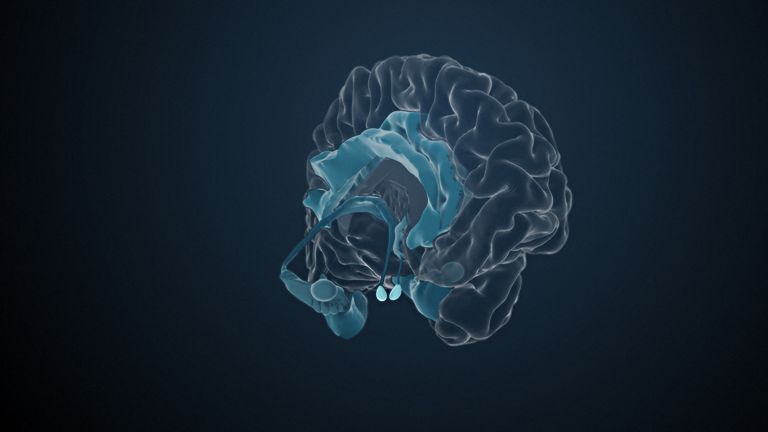
The Corpora Mamillaria
Mammillary bodies located between the cerebral peduncles – play an important role in memory formation.
28.11.2025
-
- Glossary
Diencephalon
The diencephalon (midbrain) includes the thalamus and hypothalamus, among other structures. Together with the cerebrum, it forms the forebrain. The diencephalon contains centers for sensory perception, emotion, and the control of vital functions such as hunger and thirst.
-
- Glossary
Hypophysis
The pituitary gland is an important hormone gland in the body. It hangs like a drop below the hypothalamus and is no larger than a pea. The pituitary gland consists of two parts, the anterior lobe (adenohypophysis) and the posterior lobe (neurohypophysis). The anterior lobe of the pituitary gland has the special property of being partially exempt from the blood-brain barrier, allowing it to release hormones directly into the blood.
-
- Glossary
Inhibiting hormones
Hormones produced in the hypothalamus that inhibit the release of other hormones from the adenohypophysis (part of the pituitary gland).
-
- Glossary
Neurohypophysis
The neurohypophysis is the posterior lobe of the pituitary gland. It stores the hormones oxytocin and vasopressin, which are produced in the hypothalamus, and releases them into the bloodstream when needed.
-
- Glossary
Central nucleus
The nucleus centralis belongs to the centromedial nucleus group of the amygdala. It has connections to the hypothalamus and nuclei of the brain stem and is involved in autonomous emotional responses such as fear reactions.
-
- Glossary
Cortical nucleus
The cortical nucleus is one of the cortical nuclei of the amygdala. It primarily receives olfactory information and projects to the hypothalamus, entorhinal cortex, and insula, among other areas.
-
- Glossary
Infundibular nucleus
The infundibular nucleus is also called the arcuate nucleus due to its curved shape. It is located in the hypothalamus at the base of the third ventricle and regulates hormone release from the pituitary gland via releasing and inhibiting hormones. It is therefore also involved in regulating appetite, energy balance, and growth.
-
- Glossary
Paraventricular nucleus
A nucleus of the hypothalamus whose neurons produce various hormones, including oxytocin and vasopressin, which are transported to the neurohypophysis. The PVN sends axons to the limbic system, the brain stem, and other hypothalamic nuclei.
-
- Glossary
Suprachiasmatic nucleus
A nucleus of the hypothalamus that plays a central role in circadian rhythms, including the sleep-wake cycle. It is the master clock, the body's most important internal clock, controlling melatonin production in the epiphysis. It receives direct input from the retinal ganglion cells.