Search
-
- Glossary
Cerebrum
The cerebrum comprises the cerebral cortex (gray matter), the nerve fibers (white matter), and the basal ganglia. It is the largest part of the brain. The cortex can be divided into four cortical areas: the temporal lobe, frontal lobe, occipital lobe, and parietal lobe.Its functions include the coordination of perception, motivation, learning, and thinking.
-
- Glossary
Heschl's gyrus
Heschl's gyrus is an area in the temporal lobe that was first described by Richard Heschl in 1855. It is the seat of the primary auditory cortex, i.e., the hearing center in the cerebral cortex.
-
- Basics
- Anatomy
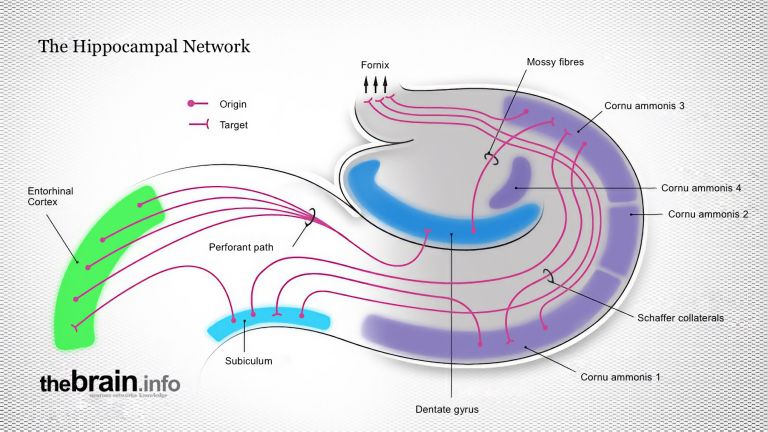
The Hippocampal Network
New memories are consolidated in the hippocampus via an excitatory circuit.
13.07.2015
-
- Glossary
Allocortex
A phylogenetically ancient region of the cortex (cerebral cortex) which, unlike the isocortex (also called neocortex), has fewer than six cell layers – in the hippocampus, for example, only three. The allocortex is divided into the paleocortex and archicortex, as well as the periallocortex, which is a transitional form between the allocortex and isocortex.
-
- Glossary
Stress hormone system
During the stress response, the sympathetic nervous system and a number of hormone glands – the hypothalamus, pituitary gland, and adrenal cortex – work together to prepare the body for increased demands. The sympathetic nervous system uses the hormones adrenaline and noradrenaline as messenger substances. Their activity increases breathing and heart rate while improving blood flow to the muscles. During the stress response, the adrenal cortex releases the hormone cortisol. It acts via negative feedback on the hypothalamus and pituitary gland, thereby slowing down further cortisol release. When the stressor subsides and the sympathetic tone decreases, the parasympathetic nervous system can regain the upper hand and bring the organism into a state of rest.
-
- Glossary
Dorsal thalamus
The thalamus is the largest structure in the diencephalon and is located above the hypothalamus. The thalamus is considered the "gateway to consciousness" because its nuclei are the transit station for all information to the cortex (cerebral cortex) – except for olfactory information, which first reaches the olfactory areas of the brain directly. At the same time, they also receive massive cortical inputs so it might be better to regard this a thalami-cortical system. The nuclei of the thalamus are grouped together. The term "gateway to consciousness" also refers to attention control, sleep-wake regulation, and consciousness modulation by the intralaminar nuclei.
-
- Basics
- Structure and Function
Structure and Function – Neurons
Different tasks require different cell types, some of which differ greatly in their biophysical properties and are highly specialized.
27.09.2021
-
- Glossary
Fissure
The strong folding of the cortex (cerebral cortex) creates fissures – from the Latin: cleft. These clefts can be used to describe individual brain structures. For example, the fissura sylvii separates the temporal lobe from the frontal lobe. Less deep clefts are often referred to as sulci.
-
- Glossary
Brodmann area
As early as 1909, neuroanatomist Korbinian Brodmann divided the cerebral cortex into different areas. He did this based on histological criteria, distinguishing these areas according to their cellular structure. It later became apparent that these different structures of the cortex are often associated with different specializations.
-
- Glossary
Temporo-parietal junction
The transition between the temporal and parietal lobes – i.e., the temporal and parietal lobes – of the cerebral cortex. Here, in the posterior region of the Sylvian fissure, information from the limbic system, the thalamus, and the visual, auditory, and somatosensory cortex is integrated. Accordingly, the temporo-parietal junction forms an anatomical and functional hub of the brain that helps us develop complex abilities, including the ability to recognize biological movement or the ability to empathize with other people.