Search
-
- Basics
- Anatomy
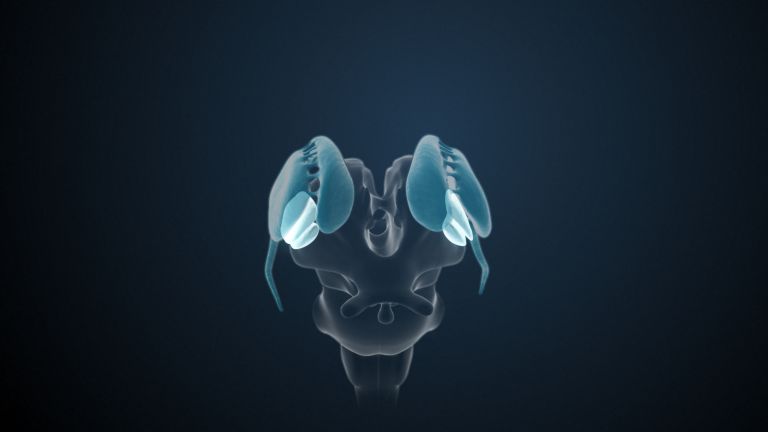
The Pallidum
The palladium provides a prime example of a highly complex feedback loop.
23.11.2025
-
- Glossary
Area F5
A part of the ventral premotor cortex located in the frontal lobe of the mammalian brain. The nerve cells in this region of the brain are involved in planning and organizing purposeful movements, especially of the mouth and hand/grasping movements. Area F5 also has historical significance: it was here that researchers first discovered mirror neurons in macaques – the nerve cells in the brains of primates that fire just as strongly when their owners observe an action as when they perform it themselves.
-
- Glossary
Praepiriform area
The praepiriform area is part of the piriform cortex in the ventral temporal lobe and belongs to the primary olfactory cortex, i.e., the primary olfactory cortex. Among other things, it contains inputs from the olfactory bulb (bulbus olfactorius) and is therefore involved in the initial cortical processing of olfactory stimuli.
-
- Glossary
Medial orbitofrontal cortex
The ventral (in humans, "lower") middle part of the frontal lobe. This part of the cortex influences complex mental processes such as planning, reward evaluation, and decision-making. Patients with lesions in the frontal lobe show personality changes and are often no longer able to control their impulses.
-
- Glossary
Nucleus accumbens
The nucleus accumbens is a nucleus in the basal ganglia that receives dopaminergic (dopamine-responsive) inputs from the ventral tegmental area. It is associated with reward and attention, but also with addiction. In pain processing, it is involved in motivational aspects of pain (reward, pain reduction) and in the effect of placebos.
-
- Glossary
Nucleus tractus solitarius
A nucleus in the medulla oblongata that serves as an important integration center for visceral information. Among other things, it processes taste stimuli (via nerves VII, IX, and X) and transmits them via the thalamus (ventral posteromedial nucleus, VPM) to the primary gustatory cortex. The NTS is also involved in the motor functions of swallowing, coughing, and respiratory control by transmitting signals to motor nuclei such as the nucleus ambiguus. These reflexes serve to protect the respiratory tract and facilitate food intake.
-
- Glossary
Striatum
The striatum is a central structure of the basal ganglia. It consists of the caudate nucleus and putamen; the nucleus accumbens is also functionally part of it as its ventral portion. As the most important input structure of the basal ganglia, the striatum plays an essential role in controlling movement sequences as well as in cognition, motivational processes, and the reward system.
-
- Glossary
Substantia nigra
A nucleus complex in the ventral mesencephalon that plays a central role in initiating and modulating movement. It appears dark due to neuromelanin. Its dopaminergic neurons project via the nigrostriatal pathways to the putamen and caudate nucleus. Failure of these neurons leads to the typical symptoms of Parkinson's disease.
-
- Glossary
Tegmentum
Tegmentum (from the Latin "tegere," meaning "to cover"). This is the ventral part of the midbrain located beneath the aqueduct. It contains nuclei such as the substantia nigra, the reticular formation, the cranial nerve nuclei, and the red nucleus.
-
- Glossary
Visual association cortices
The visual association cortices are the areas that are not involved in primary visual processing but play a major role in the interpretation and integration of visual information. They process, for example, shape, color, movement, or spatial orientation and forward information along the what pathway (ventral) for object recognition and the where/how pathway (dorsal) for spatial processing and action control.\