Search
-
- Page
The Topic Partners
27.02.2024
-
- Discover
- Milestones
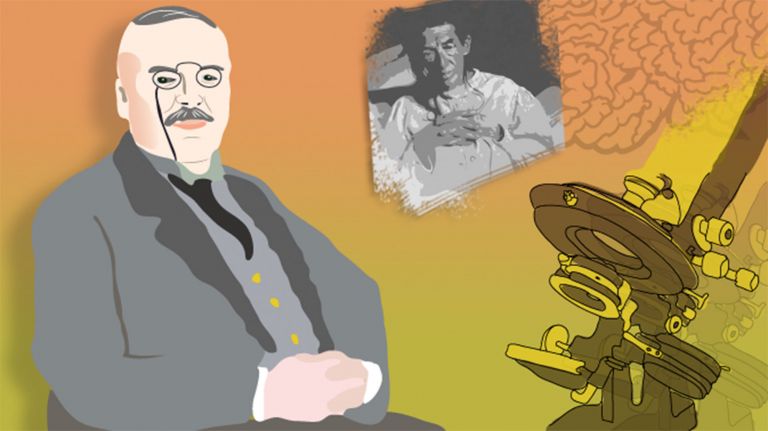
Alois Alzheimer: Mad-Doctor with a Microscope
Alzheimer's is one of the most well-known diseases of our time. But initially, it – along with its discoverer – was largely ignored.
18.09.2013
-
- Basics
- Structure and Function
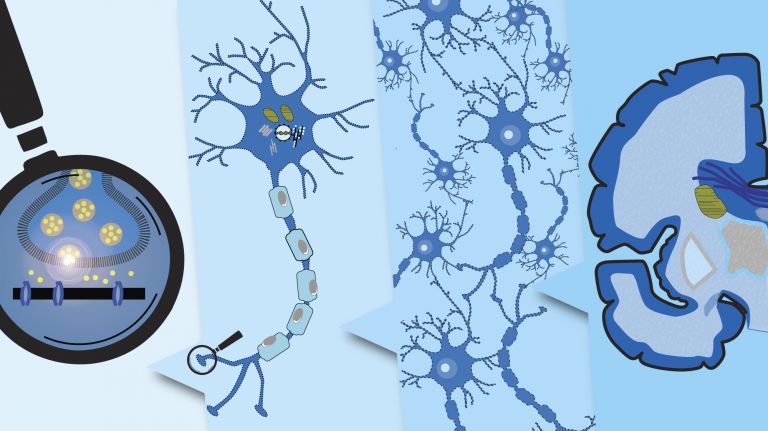
The Wonders of Life
Researchers are examining life in ever greater detail. It is revealed to be intricate and complex – the miracle becomes explainable. Yet this in no way diminishes it.
30.04.2020
-
- Percieve
- Hearing
Full Blast to the Ears
Noise not only makes you ill, it also damages your brain.
18.11.2025
-
- Glossary
Apraxia
Difficulty performing a purposeful movement, such as grasping a glass or cutting with scissors. Depending on the form of apraxia, speech or facial expressions may also be affected. The cause is not muscle weakness or paralysis, but damage to one or more areas of the brain, e.g., as a result of a stroke. In other cases, however, it is congenital.
-
- Glossary
Diffusion tensor imaging
Diffusion tensor imaging (DTI) is a form of magnetic resonance imaging. It enables researchers and physicians to visualize how water distributes itself in space over time, allowing them to reconstruct nerve pathways in the brain, for example. Certain changes, such as those caused by a stroke, can be detected more effectively with diffusion tensor imaging than with conventional magnetic resonance imaging.
-
- Glossary
dysdiadochokinesia
Medical professionals understand dysdiadochokinesia to be the limitation of the ability to perform rapid successive movements. The disorder is usually accompanied by lesions in the cerebellum, caused, for example, by a stroke.
-
- Glossary
Hemiparesis
In medicine, hemiparesis refers to incomplete paralysis of one side of the body. It occurs as a result of damage to the central nervous system, such as that caused by a stroke. Since nerve centers in the right hemisphere of the brain control movement of the extremities on the left side of the body and vice versa, hemiparesis typically occurs on the side of the body opposite to the site of the damage.
-
- Glossary
vascular
The term refers to vessels in the body in which fluids such as blood or lymph circulate. In a narrower sense, doctors refer to the network of veins, arteries, and capillaries as the "vascular system." If the vascular system is blocked, for example as a result of a stroke, less blood reaches the brain. This means that it receives less oxygen and other nutrients. This can lead to impaired cognitive functions and the development of "vascular dementia." After degenerative forms of dementia such as Alzheimer's, vascular dementia is the second most common form of this group of diseases.
-
- Discover
- Milestones
Galen: The Brain as the Central Organ
The Greek anatomist Galen recognizes the brain as the central organ of thought and sensation.
29.01.2014