Search
-
- Glossary
Striatum
The striatum is a central structure of the basal ganglia. It consists of the caudate nucleus and putamen; the nucleus accumbens is also functionally part of it as its ventral portion. As the most important input structure of the basal ganglia, the striatum plays an essential role in controlling movement sequences as well as in cognition, motivational processes, and the reward system.
-
- Glossary
Mesolimbic pathway
A system of neurons that use dopamine as a neurotransmitter and play a crucial role in emotion, reward, and substance abuse. The cell bodies are located in the subtegmental area and extend to the amygdala, the hippocampus, and – most importantly – the nucleus accumbens, where they have their terminal buttons.
-
- Glossary
Ventral tegmental area
Located in the midbrain, the uppermost section of the brain stem, is the ventral tegmental area (VTA) – a central component of the reward system. The area itself is not particularly large, but its influence is immense: the neurons of the VTA send their axons to the nucleus accumbens and widely into the prefrontal cortex (PFC), where they release the neuromodulator dopamine. In this way, they enhance learning processes, but can also contribute to the development of addictions.
-
- Basics
- Anatomy
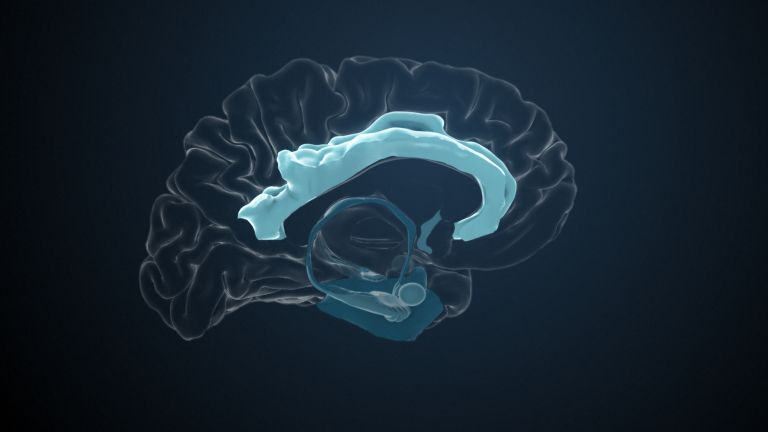
The Cingulate Gyrus
When paying attention, experiencing pain, or feeling emotions, the cingulate gyrus on the inside of the cortex becomes active.
22.09.2023