Search
-
- Glossary
Lateral nucleus
The lateral nucleus belongs to the basolateral nucleus group of the amygdala. The basolateral amygdala is the largest part of the amygdala. It receives sensory information from the temporal lobe and neuromodulatory signals from the VTA, locus coeruleus, and basal forebrain, processes them, and sends them to the central nucleus. It is important for emotional learning and fear conditioning.
-
- Glossary
Subthalamic nucleus
Although the subthalamic nucleus is a nucleus of the subthalamus in the diencephalon, it is functionally closely involved in the motor control of the basal ganglia. Damage to this nucleus can lead to temporary, uncontrolled, jerky movements of the extremities – known as ballism.
-
- Glossary
Nucleus tractus solitarius
A nucleus in the medulla oblongata that serves as an important integration center for visceral information. Among other things, it processes taste stimuli (via nerves VII, IX, and X) and transmits them via the thalamus (ventral posteromedial nucleus, VPM) to the primary gustatory cortex. The NTS is also involved in the motor functions of swallowing, coughing, and respiratory control by transmitting signals to motor nuclei such as the nucleus ambiguus. These reflexes serve to protect the respiratory tract and facilitate food intake.
-
- Glossary
Subthalamic nucleus
Although the subthalamic nucleus is a nucleus of the subthalamus in the diencephalon, it is functionally closely integrated into the motor control of the basal ganglia. It plays a role in impulse control, movement control, and inhibition of unwanted movements. Damage to this nucleus can lead to temporary, uncontrolled, jerky movements of the extremities – known as ballism. Doctors have already achieved successful treatment outcomes in both obsessive-compulsive disorder and Parkinson's disease by artificially stimulating this region with a neuroimplant.
-
- Basics
- Anatomy
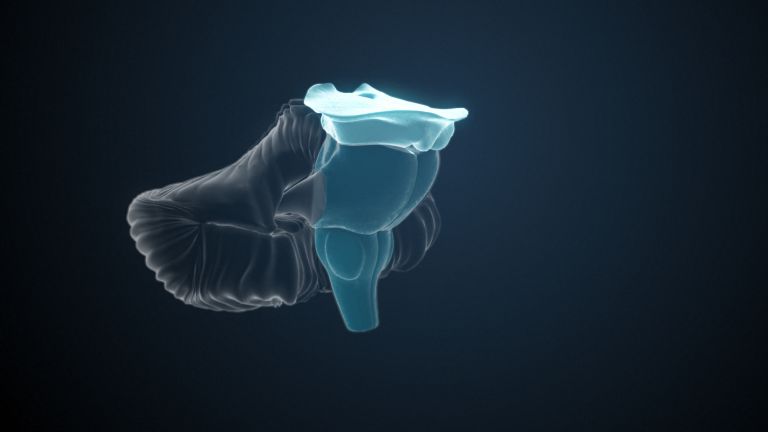
The Mesencephalon
Important neurotransmitters, an astonishing array of colors, and a water pipe – that's the midbrain.
20.09.2025
-
- News from the Institutes
Thirst and hunger neurons
New research shines light on how the brain interprets nutritional and hydration needs and turns them into action
31.03.2025
-
- Glossary
Lateral geniculate nucleus
The lateral geniculate nucleus is the section of the thalamus (the largest part of the diencephalon) where around 90% of the optic nerve axons terminate. It has a characteristic stratification into six cell layers. The nerve cells of the lateral geniculate nucleus send their projections to the visual cortex. Together with the medial geniculate nucleus, it forms the metathalamus.
-
- Glossary
Nucleus
In cell biology, the nucleus in a cell is the cell nucleus, which contains the chromosomes, among other things. In neuroanatomy, the nucleus in the nervous system refers to a collection of cell bodies – known as gray matter in the central nervous system and ganglia in the peripheral nervous system.
-
- Glossary
Central nucleus
The nucleus centralis belongs to the centromedial nucleus group of the amygdala. It has connections to the hypothalamus and nuclei of the brain stem and is involved in autonomous emotional responses such as fear reactions.
-
- Glossary
Red nucleus
The "red nucleus" owes its name to its high iron content. It can be seen with the naked eye as a large, round, reddish-colored nucleus in the midbrain. It belongs to the extrapyramidal motor system, and its central tasks are posture and muscle tone.