Search
-
- Glossary
Basal ganglia
The basal ganglia are a group of subcortical nuclei (located beneath the cerebral cortex) in the telencephalon. The basal ganglia include the globus pallidus and the striatum, and, depending on the author, other structures such as the substantia nigra and the subthalamic nucleus. The basal ganglia are primarily associated with voluntary motor function, but they also influence motivation, learning, and emotion.
-
- Glossary
Depression
A mental illness whose main symptoms are sadness and a loss of joy, motivation, and interest. Current classification systems distinguish between different types of depression.
-
- Glossary
Dopamine
Dopamine is an important neurotransmitter in the central nervous system that belongs to the catecholamine group. It plays a role in motor function, motivation, emotion, and cognitive processes. Disruptions in the function of this transmitter play a role in many brain disorders, such as schizophrenia, depression, Parkinson's disease, and substance dependence.
-
- Glossary
Cerebrum
The cerebrum comprises the cerebral cortex (gray matter), the nerve fibers (white matter), and the basal ganglia. It is the largest part of the brain. The cortex can be divided into four cortical areas: the temporal lobe, frontal lobe, occipital lobe, and parietal lobe.Its functions include the coordination of perception, motivation, learning, and thinking.
-
- Glossary
Cingulate gyrus
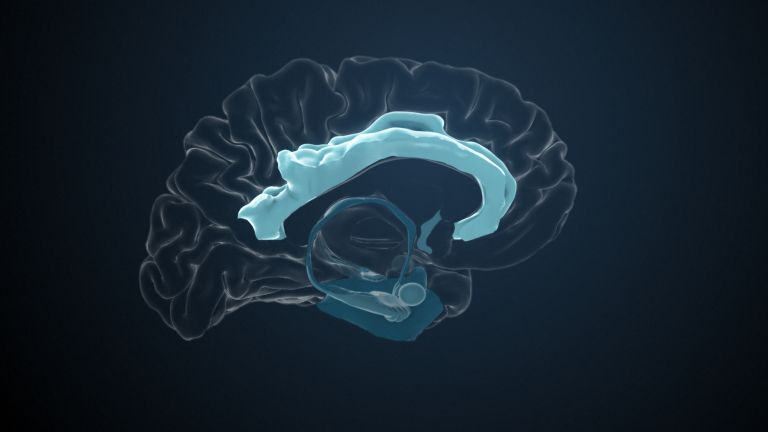
The cingulate gyrus is an important part of the limbic system in the cerebrum. This strip of cortex runs medially in the cerebrum, directly above the corpus callosum. Among other things, it is involved in emotions and memory. Through its connections to limbic and autonomic centers, it can also influence autonomic responses (e.g., heart rate, blood pressure). The anterior (front) region in particular is also associated with attention, motivation, error monitoring, and emotion regulation.
-
- Glossary
Limbic cortex
The limbic cortex primarily comprises the cingulate gyrus and adjacent structures such as the entorhinal cortex. It is part of the limbic system, which also includes regions such as the hippocampus and the amygdala. The limbic system plays a central role in processing emotions, motivation, and instinctive behavior.
-
- Glossary
Medial nuclei
The medial thalamic nuclei, especially the mediodorsal nucleus, are located in the medial thalamus and are closely connected to the prefrontal cortex and the limbic system. They are primarily responsible for higher cognitive functions such as planning, attention, and working memory, but are also involved in processing emotions and motivation. In addition, they integrate complex information from different areas of the brain.
-
- Glossary
Caudate nucleus
Part of the basal ganglia, it forms the striatum together with the putamen. Anatomically, the caudate nucleus is located frontally in the center of the brain and extends backward, forming a C shape. It consists of a head (caput nuclei caudati), a body (corpus nuclei caudati), and a tail (cauda nuclei caudati). In contrast to the more motor-related parts of the basal ganglia, this area is strongly connected to the prefrontal cortex in addition to its motor functions. As a result, this part of the striatum is also heavily involved in cognition, motivation, and emotion.
-
- Topic
Soccer
Don't think, just do it!
-
- Think
- Emotions
Addicted to Love
They say love is blind. Neurobiologists have discovered that this is true. What's more, it's also addictive.
20.12.2011