Search
-
- Glossary
Parietal lobe
The parietal lobe is one of the four large lobes of the cerebral cortex. It is located behind the frontal lobe and above the occipital lobe. Somatosensory processes take place in its anterior region, while sensory information is integrated in its posterior region, enabling the handling of objects and spatial orientation. In addition, the parietal lobe is involved in attention, the recognition of body parts and objects, as well as linguistic and mathematical abilities.
-
- News
- Question to the brain
How do Placebo Drugs work?
What actually happens in the brain during the placebo effect?
02.02.2025
-
- Percieve
- Hearing
From Wiggling to the wonderful Variety of Sounds
It is a long way from purely mechanical vibrations to the world of sounds and tones.
17.10.2025
-
- Glossary
Cerebrum
The cerebrum comprises the cerebral cortex (gray matter), the nerve fibers (white matter), and the basal ganglia. It is the largest part of the brain. The cortex can be divided into four cortical areas: the temporal lobe, frontal lobe, occipital lobe, and parietal lobe.Its functions include the coordination of perception, motivation, learning, and thinking.
-
- News
- Question to the brain
How can Synesthesia be explained?
Is it true that some people experience sensory impressions mixing together? How does this happen?
13.10.2024
-
- Percieve
- Hearing
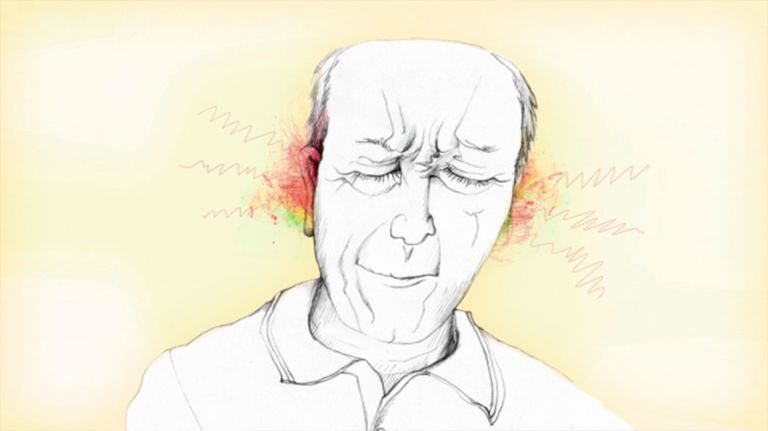
Ringing in the Ears
Tinnitus: The annoying whistling and buzzing does not originate in the ear, but in the brain.
28.10.2025
-
- Glossary
Prefrontal cortex
The prefrontal cortex (PFC) forms the front part of the frontal lobe and is one of the brain's most important integration and control centers. It receives highly processed information from many other areas of the cortex and is responsible for planning, controlling, and flexibly adapting one's own behavior. Its central tasks include executive functions, working memory, emotion regulation, and decision-making. In addition, the PFC plays an important role in the cognitive evaluation and modulation of pain.
-
- Glossary
Medial orbitofrontal cortex
The ventral (in humans, "lower") middle part of the frontal lobe. This part of the cortex influences complex mental processes such as planning, reward evaluation, and decision-making. Patients with lesions in the frontal lobe show personality changes and are often no longer able to control their impulses.
-
- Percieve
- Hearing
From Sound to Word
Widely distributed brain regions make the miracle of language possible.
13.10.2023
-
- Diseases
- Intruders
Constant Stress on the Brain
Stress, inflammation, cell death – how environmental toxins damage the brain.
02.05.2023