Future Regeneration
Published: 30.04.2020
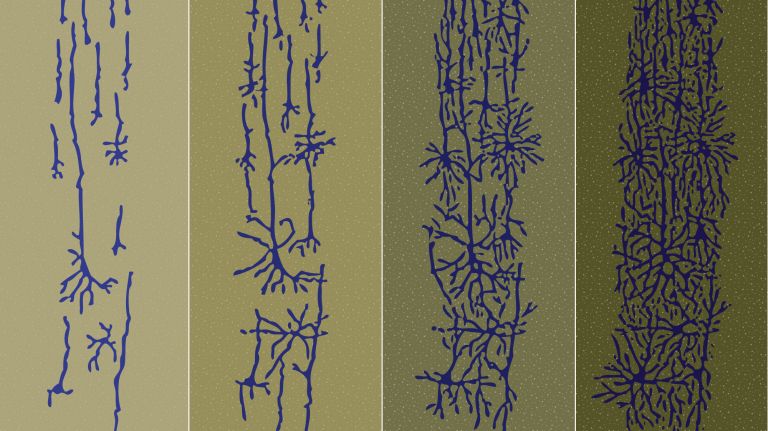
The brain is amazing, but vulnerable – Neurodegeneration and stroke can cause serious damage. This makes effective treatments all the more important. In fact, there is hope: A stem cell therapy is working in mice; the new cells are actually forming connections – even over long distances.
Collective term for diseases in which nerve cells gradually lose their structure or function until they eventually die. In many cases, misfolded proteins are the trigger – such as certain forms of the proteins Beta-amyloid and tau in the case of Alzheimer's disease In other diseases, such as Parkinson's disease or Huntington's disease, proteins within the neurons are not broken down properly. As a result, toxic aggregates are deposited there, leading to the respective disease symptoms. While Huntington's disease is clearly genetic, in Parkinson's and Alzheimer's there appear to be certain Gene variants that promote their development. None of these neurodegenerative diseases can be cured at present.
Cerebral apoplexy
In a stroke, the brain or parts of it are no longer supplied with sufficient blood, which impairs the supply of oxygen and glucose. The most common cause is a blockage in an artery (ischemic stroke), less commonly a hemorrhage (hemorrhagic stroke). Typical symptoms include sudden visual disturbances, dizziness, paralysis, speech or sensory disturbances. Long-term consequences can include various sensory, motor, and cognitive impairments.
Neurodegeneration
Collective term for diseases in which nerve cells gradually lose their structure or function until they eventually die. In many cases, misfolded proteins are the trigger – such as certain forms of the proteins beta-amyloid and tau in the case of Alzheimer's disease. In other diseases, such as Parkinson's disease or Huntington's disease, proteins within the neurons are not broken down properly. As a result, toxic aggregates are deposited there, leading to the respective disease symptoms. While Huntington's disease is clearly genetic, in Parkinson's and Alzheimer's there appear to be certain gene variants that promote their development. None of these neurodegenerative diseases can be cured at present.
Beta-amyloid
A peptide consisting of 36 to 42 amino acids that is considered the main component of senile plaques and is believed to be responsible for the development of Alzheimer's disease. The starting product is the amyloid precursor protein (APP). Certain enzymes in the cell membrane cut the precursor protein into peptides of various sizes. Amyloids consisting of 40 and 42 amino acids are found in senile plaques, with the 42-amino-acid product forming aggregates particularly quickly, at least in the Petri dish. The normal function of beta-amyloid has not yet been conclusively clarified.
Alzheimer's disease
Morbus Alzheimer
Alzheimer's disease is a progressive neurodegenerative disorder characterized by cortical atrophy, nerve cell loss, synapse loss, and deposits of amyloid plaques and neurofibrillary tangles, leading to dementia and loss of function. Early symptoms include memory problems, speech disorders, executive deficits, depressive moods, and subtle personality changes. As the disease progresses, global cognitive impairment, aphasia, agnosia, apraxia, and behavioral abnormalities such as apathy, restlessness, and sleep disorders occur. The disease was first described in 1907 by Alois Alzheimer.
Parkinson's disease
Morbus Parkinson
Parkinson's disease is one of the most common neurological disorders, caused by the death of dopamine-producing neurons in the substantia nigra, leading to a neurotransmitter imbalance in the basal ganglia. Symptoms usually begin late in life with mild tremors (resting tremor), increasing stiffness of the limbs, and slowed voluntary movements (bradykinesia). Later, postural instability, balance disorders, and difficulty walking occur. Other typical features include rigid facial expressions (hypomimia), a shuffling gait, and muscle stiffness (rigor). The disease is incurable, but its symptoms can be treated with medication (e.g., L-dopa, dopamine agonists) or surgery involving deep brain stimulation (brain pacemaker).
Huntington's disease
Huntington's disease is a progressive and fatal hereditary disease that manifests itself in the brain. It is characterized by dyskinesia, dementia, and behavioral and psychological changes. To date, there is no cure, although scientists have a relatively good understanding of its molecular causes. The Huntington's gene of those affected contains up to 200 copies of a specific base triplet (group of three bases). This causes the cells to produce a defective protein, which primarily forms deposits in the striatum of the brain. This leads to degeneration of the neurons in the basal ganglia and the cortex.
Gene
Information unit on DNA. Specialized enzymes translate the core component of a gene into ribonucleic acid (RNA). While some ribonucleic acids perform important functions in the cell themselves, others specify the order in which the cell should assemble individual amino acids into a specific protein. The gene thus provides the code for this protein. In addition, a gene also includes regulatory elements on the DNA that ensure that the gene is read exactly when the cell or organism actually needs its product.
stroke
Cerebral apoplexy
In a stroke, the brain or parts of it are no longer supplied with sufficient blood, which impairs the supply of oxygen and glucose. The most common cause is a blockage in an artery (ischemic stroke), less commonly a hemorrhage (hemorrhagic stroke). Typical symptoms include sudden visual disturbances, dizziness, paralysis, speech or sensory disturbances. Long-term consequences can include various sensory, motor, and cognitive impairments.